The Christian Science Monitor notes that holiday office parties are back in vogue after being shunned due to the post 9-11 economy. But, instead of a mere recitation of more corporate holiday lore, the CSM acknowledges the indexical symbol these festivities mark for both employers and employees:
In some ways, the party's comeback parallels the rise and fall of the national economy: excursions to exotic locales in the halcyon days of the 1990s contrast sharply to celebrating on someone else's tab. But it's not just a night of toasts and rubbing elbows. It's also a window into the priorities of top management, a barometer of morale, and a chance, however fleeting, to let gratitude ring.
Tuesday, December 21, 2004


"Mr. Mandate" Accommodates Reality

The wit and wisdom of George II

Dailykos reports that on the eve of his second inaguration Bush is going to be the most unpopular second-termer ever and, finally, most Americans agree that the war in Iraq was a blundering mistake.
And writing in Slate Timothy Noah summarizes his meandering stream-of-consciousness press conference yesterday, especially his take on Social Security, with this insighful analysis:
Until now, Bush has seemed either too dumb or too stubborn to recognize that Social Security privatization will necessitate either hitting up taxpayers or reducing Social Security benefits. But watching Bush in today's press conference, I realized that there was another possibility: Bush is simply too cynical to acknowledge practical realities of which he is well aware. Maybe he figures that accommodating those realities simply isn't his job. Maybe he's thinking: Let Congress get the blame for insisting that two plus two equals four!
Education's Big "Sucking Sound"
The NYT has an article dear to my jaundiced heart today on foreign students fleeing US graduate schools. First, this doesn't bode well for the $13 billion they bring to the US economy annually, nor international competition for academics in the future. One choice observation follows:
In August a delegation of education officials from Singapore visited Mary Sue Coleman, the president of the University of Michigan, at the Ann Arbor campus. They took over a conference room, set up computers and peppered her with questions about tuition policy, fund-raising, governance and research, Dr. Coleman recalled. They wanted to know how Michigan became a prominent university, and how it was run today.
"Eventually they'll reap the benefits of this work," Dr. Coleman said. "Singapore will create world-class universities. Other countries are taking the same approach. We're going to have enormous competition. We'd better be prepared for it."
Now, Coleman was my president at Iowa (before moving to Michigan), and I knew her to do some "dodo" things, but this really raises my ire. Decades ago, US manufacturers gladly gave tours to foreign firms hoping to emulate the American industrial machine. They did. The result was a dwindling manufacturing base, and a downward spiral of real wages and trade deficits. Now it seems, the "best and brightest" are similarly giving away the shop to countries only too glad to heavily subsidize their higher educational systems at time when we are cutting and cutting in the name of efficiency. Come back in 20 years and see how well our universities fare.
Monday, December 20, 2004
What is "Anthropologist" in Farsi?
A great news Monday. The Guardian reports that with 75,000 blogs in the Farsi language, Iran is now becoming a blogging center. In part, this is due to recent crackdowns on print media by the religous judiciary, and the ire it has drawn from young, educated Iranians. Please do take a look.
The internet has opened a new virtual space for free speech in a country dubbed the "the biggest prison for journalists in the Middle East", by Reporters sans Frontieres (RSF). Through the anonymity and freedom that weblogs can provide, those who once lacked voices are at last speaking up and discussing issues that have never been aired in any other media in the Islamic world. Where else in Iran could someone dare write, as the blogger Faryadehmah did, "when these mullahs are dethroned ... it will be like the Berlin wall coming down ..."?
The internet has opened a new virtual space for free speech in a country dubbed the "the biggest prison for journalists in the Middle East", by Reporters sans Frontieres (RSF). Through the anonymity and freedom that weblogs can provide, those who once lacked voices are at last speaking up and discussing issues that have never been aired in any other media in the Islamic world. Where else in Iran could someone dare write, as the blogger Faryadehmah did, "when these mullahs are dethroned ... it will be like the Berlin wall coming down ..."?
Technology and the Election
"If Hitler had an email list and some online tools - yeah, we'd be speaking a different language now."
BOPNews has a great election assessment from Zach Exley, former online communications chief for the Kerry-Edwards campaign, who spoke recently at Harvard's Internet and Society 2004 Conference. His take is not that friendly to those who think that technology is the answer to getting out the vote.
The take away was pretty stark: after a year of Panglossian happy-talk from media outlets like NPR, the tools proved not to be magic: and the much-lauded "conversation" proved to be an irrelevant distraction from building a real world field organization. None of this should surprise most readers, but the fact that this is even considered controversial shows how much techno utopians have to learn.
Rose Parade Survival Tips
Yesterday's LA Times Magazine has a small piece on surviving camping out for the Rose Parade. Keep checking back here for more details. The AA is going to post pictures and play-by-play happenings surrounding the *real* Rose Parade - meaning at the other end of the 5.5 mile route. I guarantee that it's nothing like you've ever seen on the TV come a groggy New Year's Day morning.
And, from the Pasadena Police Department:
What you can do:
A permanent position on the sidewalk may be maintained along the parade route beginning at noon on Dec. 31.
The “Blue Line” is the honor line. All persons and property such as blankets, chairs, etc., must remain on the curb and are not permitted in the street until 11:00 p.m. on Dec. 31. At that time
spectators may move out to the honor line.
Overnight camping is permitted only on the night of December 31.
Fires will only be permitted if it is not windy. Fires must be in fire safe containers which are off the ground. The Pasadena Fire Department will issue citations to violators.
What you can’t do: (Notice the anti-tortilla-throwing ordinance)
Fireworks are prohibited in the City of Pasadena except as a part of scheduled official events.
Vehicles obstructing emergency lanes will be towed. Ladders and scaffolds are not allowed.
Couches or boxes of any type that can be used as stools or seats are prohibited.
Saving space or tying off an area is not allowed. All ropes will be removed.
Unoccupied or extra chairs will be confiscated.
Selling public space other than grandstand seating is illegal and violators will be arrested.
Tents are not allowed.
Throwing any projectile into the Parade, including seemingly harmless items such as tortillas, marshmallows, flowers etc., is prohibited.
It is illegal to buy or sell horns along the parade route. It is illegal to sell any items along the parade route without a permit. Violators will be arrested and their items confiscated. Walking in the street and/or selling in the street is not permitted.
Anthro Tech
Another example of anthropologists alive and well in "the real world," courtesy of the British magazine New Scientist.
Anthropologists' insights are not just for the future: they have already contributed to making existing technologies easier to use. Perhaps the most familiar example is the big green Copy button on photocopiers. Anthropologist Lucy Suchman famously suggested it when working at Xerox in the 1980s, after seeing how frustrated people became with the complexity of the machines of the day.
Now based at Lancaster University, UK, Suchman says major technology companies often consult anthropologists, although their influence often goes unnoticed.
Travis Breaux, an anthropologist and computer scientist at North Carolina State University in Raleigh, expects this kind of input to become more common. "As technology becomes more pervasive, the role of the anthropologist in its development will continue to grow," he predicts.
"Ethnographic methods are being applied to friend-finding networks such as Friendster, multi-player online role-playing games such as Everquest and online dating systems," Breaux says. And these networks and games, he says, are returning the compliment by proving useful to social scientists in their academic research. "Future technologies will in turn be affected by our studies of the way people behave on these networks."
Cover of the Day
"For sharpening the debate until the choices bled, for reframing reality to match his design, for gambling his fortunes—and ours—on his faith in the power of leadership, [Guess Who] is TIME's [1942] Person of the Year."
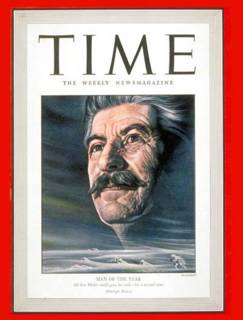
Uncle Joe Resurected
Actually, the quote is from Time's introduction to the current 2004 Person of the Year - George W. Bush. But since we are in the season of reflection, it makes one think.

Uncle Joe Resurected
Actually, the quote is from Time's introduction to the current 2004 Person of the Year - George W. Bush. But since we are in the season of reflection, it makes one think.
Dueling Quotes
From the AP wires, separated by a couple years:
"I have heard the anguish in his voice and seen his eyes when we talk about the danger in Iraq and the fact that youngsters are over there in harm's way. And he's a good, decent man. He's a caring fellow."
"I looked the man in the eye. I was able to get a sense of his soul."
Both are from "Mr. Mandate" George Bush. The first is his defense of Sec. Rumsfeld's latest PR debacle. The second is his assessment of Vladimir Putin, who has since turned from the west and embraced good-old Russian despotism. Makes you wonder about his psychiatric skills.
Poor Little Rich Boys
The London Observer briefs us on the new post-capitalist afflicition, "affluenza."
....psychologists have identified the condition of 'affluenza' as a malaise affecting some who become rapidly wealthy or tire of their riches. Symptoms include materialism, but also shame, guilt and a sense of disorientation.
OK, but I'm willing to give it a go.
....psychologists have identified the condition of 'affluenza' as a malaise affecting some who become rapidly wealthy or tire of their riches. Symptoms include materialism, but also shame, guilt and a sense of disorientation.
OK, but I'm willing to give it a go.
What Would This Guy do to Smokey the Bear?
Today's LA Times reports that a builder is suing two US Forest Service employees for "racketeering:"
San Diego businessman Irving Okovita, who filed the suit, alleges that the Eliasons, Zimmerman and Sandy Steers, a local environmental activist, engaged in a criminal conspiracy to block the Marina Point development, a luxury condominium project Okovita wants to develop with an Arizona company in this hamlet on the north shore of Big Bear Lake.
Okovita's attorney, S. Wayne Rosenbaum of San Diego, said his client had lost millions of dollars because of delays in the project, which would include 132 condominiums, a 175-slip marina and tennis courts.
Now this happens to be in an area with a dense stand of trees that is used for nesting by bald eagles. In fact, the two employees being sued are themselves the bald eagle experts for the San Bernadino National Forest. But this bigger question is this: Okovita has owned this slip of land since 1981, but has declined to develop it for the past 23 years. Why now? Perhaps because of the unprecedented building boom in Southern California which, most experts agree, is a big soap bubble waiting to burst. So why these people? Because they were knowledgeable government employees sworn to protect the natural resources of the US who urged officials not to allow the project.
The three Forest Service employees and Steers said the charges against them are patently false. The government workers maintain that they were acting in their official capacity as Forest Service employees and have done nothing wrong. Steers said Okovita's suit was brought partly "to intimidate other activists from speaking out. That won't work," she said.
The next time you hear a builder gripe about "the process," ask them if they think they're local police, fire, medical, and safety service employees are on par with Tony Soprano. That's what this lawsuit maintains. Mr. Okovita is therefore automatically nominated for the next Red Turkey Award.
A Happy Festivus to All!
This Thursday marks Festivus, the hilarious anti-commercial holiday popularized by Seinfeld and created in real life by Dan O'Keefe. Yesterday, the NYT ran a front-page article on the Fashion & Style section, complete with a photo of Kramer and his protest sign "Festivus Yes! Bagels No!"
For even more particulars, check out the Wikipedia encyclopedia entry:
Festivus is a fictional holiday popularized by Frank Costanza (played by Jerry Stiller) on the popular American television comedy Seinfeld. Some fans of the show now celebrate this fictional holiday in real life.
Festivus is held on 23 December of each year. It was created as a response to the commercialism of the other December holidays. Its slogan is "A Festivus for the rest of us."
The Festivus idea came to the show through writer Daniel O'Keefe. His father, Dan O'Keefe, invented the holiday in 1966.
Main elements of Festivus
The Festivus celebration includes three major components:
The Festivus Pole. During Festivus, an unadorned aluminum pole is displayed, apparently in opposition to the commercialization of decorated Christmas trees, and because the holiday's creator, Frank Costanza, "find[s] tinsel distracting."
The Airing of Grievances. At the Festivus dinner, the celebrant tells their friends and family all of the instances where they disappointed the celebrant that year.
The Feats of Strength. The head of the family tests his or her strength against one participant of the head's choosing. Festivus is not considered over until the head of the family has been pinned. A participant is allowed to decline to attempt to pin the head of the family only if they have something better to do instead.
Friday, December 17, 2004
Weekend Ideas
Looking for something interesting this weekend? The Point Fermin Lighthouse in San Pedro just turned 130 years old this week and was recently opened after a lengthy restoration. It's located in the midst of a nice park on the bluffs just below the Korean Peace Bell and near the Fort MacArthur Museum.
On the other hand, if you're into post-industrial aethetics Tom Vanderbilt at Design Observer has a piece on exploring the old Bethlehem Steel plant.
Finally, if you enjoy sailing, or just following record-breaking voyages, British sailor Ellen MacArthur is currently attempting to set a new world record for a single-handed circumnavigation non-stop (that means 26,000 miles around the globe without a port o' call) in the 75-ft trimeran B&Q. She has until February 9 to cross the line between Ushant, France and Lizard, England. All the action is being relayed via the Team Ellen website complete with webcams and all the navigation station info.
Holiday Big Bites

LA's totemic street food.
Chicago might have the best hot dogs, Philadelphia the best cheese steaks and hoagies, New York the best hero sandwiches, but Los Angeles, for a long time, has been and remains a "burger town." The ubiquitous taco trucks are becoming more familiar, but The Food Section has a recent tour of the best burger joints around town, including the famous In-N-Out Double-Double (mentioned prominently in The Big Lebowski).
Several years ago Public Television aired the memorable documentary Burger Town, which firmly placed Los Angeles and this uniquely American food together in the annals of food history:
The hamburger is hands down our all-time favorite food. The average American consumes nearly thirty pounds of hamburger a year - three burgers per person per week.
Burger Town not only unearths the origins of the hamburger and traces its ascent into popular cultural icon, it shows why Los Angeles can lay claim to taking its burgers more seriously than any other city in America. From the Pacific Coast Highway to the sprawling east L.A. desert towns, Los Angeles is home to some of the greatest hamburger palaces and coffee shops in America.
The peace-time prosperity that followed World War II was a glorious time for drive-ins. Los Angeles was the town where McDonald's Hamburgers would shape the future of the burger. The McDonald brothers' first drive in was built in San Bernardino in 1948. When it changed from car hops to self-service, it began a revolution in 15 cent burgers that would sweep the nation and transform the suburban landscape of America. Living legend Richard McDonald, founder of this most successful fast-food chain in history, is interviewed along with America's foremost burger historians.
Burger Town also chronicles the rise of other national hamburger chains and tours the best burger joints in Los Angeles. Packed with clips of vintage burger commercials, nostalgic clips of early burger joints. and interviews with America's foremost burger historians, Burger Town is a mouth-watering look at America's love affair with the hamburger.
Look for it late at night on your favorite public television station, preferably when you have the munchies.
My Peering Eyes, My Cheating Heart
Now the posts below show that, for the average American worker, hard work, being "good," and "following the rules" doesn't seem to help much in the current economy. What about education? The Chronicle of Higher Education has released a special report on plagiarism today (free content), and find some startling zingers:
Among the cases we found were a political scientist who swiped five pages of his book from a journal article, a historian who cribbed from an unpublished dissertation, and a geographer whose verbatim copying appears to span his lengthy career.....In one of the rare surveys conducted about plagiarism, two University of Alabama economists this year asked 1,200 of their colleagues if they believed their work had ever been stolen. A startling 40 percent answered yes. While not a random sample, the responses still represent hundreds of cases of alleged plagiarism.
We expect that from economists and the secondary data crowd.
More of The Big Picture
More news is coming out today from The White House Conference on the Economy showing that the WH team, if not "off message" is, at least, "out of focus" when it comes to the basis of sustaining a consumer-driven domestic economy: jobs, jobs, jobs.
Two good graphs from Jobwatch.org tell the tale. Since WWII we have had five recessions, the latest of which was supposed to have already ended. But 44 months after the recession began, how did jobs recover?
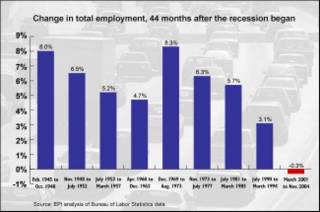
This makes things look just as bad as during the Great Depression.
And while the WH claims that job growth is "strong," that has only been for government job creation, not the private sector.
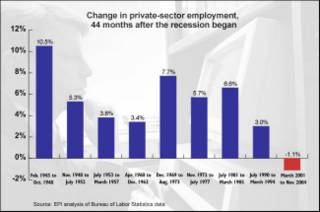
Now this comes as Bush is pushing for privitization of Social Security, arguing that retirement savings are best left to the financial markets and private savings accounts. Now if it were that great, why have other countries moved away from private retirement accounts? And if no jobs are being created in the private sector, then where will the extra funds come from to pay for it? Alas, the good citizens of this country can't put everything on a credit card, as our exective branch does.
Two good graphs from Jobwatch.org tell the tale. Since WWII we have had five recessions, the latest of which was supposed to have already ended. But 44 months after the recession began, how did jobs recover?

This makes things look just as bad as during the Great Depression.
And while the WH claims that job growth is "strong," that has only been for government job creation, not the private sector.

Now this comes as Bush is pushing for privitization of Social Security, arguing that retirement savings are best left to the financial markets and private savings accounts. Now if it were that great, why have other countries moved away from private retirement accounts? And if no jobs are being created in the private sector, then where will the extra funds come from to pay for it? Alas, the good citizens of this country can't put everything on a credit card, as our exective branch does.
Deficits Don't Matter?
President Bush, you're no President Reagan.
Kevin Drum reminds us in the Washington Monthly that the federal deficit of the early 1980's was only erased through many additional tax increases. This, of course, flies in the face of contemporary political mythology, but then the current WH crew isn't much into the minutiae of facts and figures. As governor of California, Reagan also raised taxes when confronted with fiscal emergencies, and did it after his (in)famous 1981 tax cut. So while he spoke like a conservative, he did have some grounding in reality and acted accordingly. Bush II, however, believes in the message itself, uncoupled from material constraints.
The answer, of course, is that Reagan didn't grow his way out of the deficits caused by his 1981 tax cut. As the chart on the right shows (adapted from this Treasury report), he raised taxes twice in 1982, and then raised them again in 1983, 1984, 1985, 1986, and 1987. But even with those seven tax increases and several years of strong growth, he still didn't get rid of his deficit.
It took an eighth tax hike from George Bush Sr. in 1989, a ninth in 1990, a tenth from Bill Clinton in 1993, and then another economic boom to erase the deficit. Sure, a strong economy helped, but without all those tax increases the deficit would never have disappeared.
So why don't more people understand this? I think it's because no one wants them to. Republicans don't like to talk about this because it ruins the conservative foundational myth of Reagan the tax cutter as well as the policy myth of tax cuts as the engine of economic growth. They prefer to preserve the mythology.
Democrats, for their part, like to portray Reagan as an inflexible and simpleminded ideologue, and admitting that he raised taxes several times doesn't fit their myth. What's more, they're scared silly about even mentioning tax increases these days. So they don't.
The end result is that very few voters understand that the Reagan deficit eventually went away only after ten major tax increases that were cumulatively bigger than the famous 1981 tax cut. And because people don't understand that, they figure that maybe Bush can grow his way out of the deficits he's created. After all, Reagan did it.
Thursday, December 16, 2004
'Bye Tavis
Today marks a sad date for fans of public radio. Tavis Smiley airs his last show on National Public Radio after three years and sat down with Salon.com for an interview published today. As an avid listener, I appreciated Smiley's invitation to prominent African-Americans, even self-labelled conservatives, to join the conversation on timely topics. It was a sorely needed voice on the airwaves.
But from the outset I wondered how The Tavis Smiley Show would be received by the paying, if not loyal, NPR audience, even though it was the first NPR show to originate from Los Angeles. Locally, two stations aired the show: KCRW in progressive Santa Monica by the sea, and KPCC in conservative Pasadena in the foothills. KCRW slated him for the morning commute, but listeners complained, wanting the unchanging voices of Morning Edition. So they stuck him at 5-6am, which might have gone down well with truck drivers looking for breakfast, but killed the show. It was taken off the station some time ago. Yet, KPCC aired him consistently during quality time, 8-9pm, from the start.
Now why a station from a city known as the "People's Republic of Santa Monica" should effectively "whiten" the airwaves is surprising. But then, perhaps not. The Salon interview also includes this appraisal of top-tier managment at NPR:
Public radio has been enormously successful in recent years, thanks in part to David Giovannoni, a public-radio analyst the New York Times calls "quite possibly the most influential figure in shaping the sound of National Public Radio today." Giovannoni's research shows that NPR's core audience -- affluent white baby boomers -- doesn't want programming geared toward minorities, or young people, even in moderation. Every time they turn on the radio, he argues, that audience wants to hear the dulcet tones of the Linda Wertheimer sound-alikes who've come to define public radio. Many stations believe that following the advice of Giovannoni and his disciples means they will attract more listeners, which means more donations. As a result, their programming has become aggressively unsurprising, rarely straying far from the predictable approach of "Morning Edition" and "All Things Considered."
KCRW showed its true colors too, not so long ago. Back in March, commentator and performer Sandra Tsing Loh was fired by GM Ruth Seymour for using the "f-word" during her weekly commentary that was meant to be deleted by the recording engineer. It was not. So Seymour, worried about FCC meddling, bounced Tsing Loh, and was met with widespread criticism. The incident brought national attention and Seymour had to rescind her decision. Thankfully, Tsing Loh is now at KPCC.
But the decision by Tavis Smiley to leave NPR still leaves me - and I hope others - with a queasy feeling about the future of public radio. Will the "public" in public radio come to mean "pay as you go" programming, or will stations try to adhere to original goals of programming, bringing diverse voices from the local community to a range of issues not addressed by commercial stations. The "white out" at NPR doesn't bode well for the latter.
Wednesday, December 15, 2004
Purloined Pickles
From my old haunts in Iowa City, and the Press-Citizen:
Hearing in Pickles case delayed
By DAVID PITT Associated Press Writer
DES MOINES — A Polk County judge on Wednesday delayed a hearing in the case of Pickles, the disqualified 2002 Iowa State Fair 4-H grand champion steer.
The hearing, which has been delayed several times to fit the schedules of attorneys and Judge Arthur Gamble, has been moved to Friday, a court clerk said. It had been scheduled for Wednesday.
Pickles' owner, Jenna Sievers, who was 16 at the time when she showed the animal at the farm competition, was accused of switching animals between the December 2001 weigh-in and the August 2002 state fair competition.
Sievers and her father, former state Sen. Bryan Sievers and her mother, Lisa Sievers, publisher of the Muscatine Journal, have insisted they did not cheat and have aggressively defended themselves through a two-year legal process.
The state fair board disqualified Pickles claiming nose prints taken of a calf did not match nose prints of Pickles. The board also did not believe Sievers' claim that the calf gained an average of 9 pounds a day over a 30-day period.
After the board disqualified Pickles, the Sievers' appealed to an administrative law judge, presenting testimony from fingerprint experts that nose prints were unreliable.
That judge concluded last November that Pickles should keep the title.
The State Fair Board overturned the judge's decision in February, upholding Pickles' original disqualification. The Sievers appealed to district court.
The ruling could be appealed to the Iowa Supreme Court.
Winning the case also means Jenna Sievers could collect a portion of the $16,000 paid for Pickles at the 2002 state fair's livestock auction. The money remains in escrow until the case is resolved.
Pickles' carcass was placed in a freezer at Iowa State University.
The Season of Hedonism
From the consumption files we see that shoppers admit to personal shopping during the season that meant to be about giving, not receiving:
"Our customers feel it's all right to be hedonistic," Mr. Chinniah said, "especially at holiday time."
An informal survey of retailers suggests that the hedonism is by no means limited to luxury outposts like Bergdorf Goodman. There is even a term to distinguish the practice of gratifying one's own desires from more selfless giving. "People are not really buying gifts, except little things like candles," a saleswoman at Emporio Armani on Madison Avenue said last Friday. "It's really greed buying, but we don't call it that," said the woman, who cannot be named under Armani corporate policy. "Self-purchase," she explained, is the industry euphemism of choice.
British anthropologist Daniel Miller has been publishing on consumption, identity, and consumer behavior for twenty years and wrote A Theory of Shopping, among others, which draws heavily on the work of French theorist Georges Bataille. An essay on his views of gift-giving and sacrifice can be found here. And for further engaging consumption studies, try Culture and Consumption by Grant McCracken, who also runs the blog Cultureby (see sidebar).
Surf's Up in Hawaii

50 foot waves expected to hit Hawaii.
One person's disaster is another's sporting event. While not a surfer personally, I know some avid surf worshipers, including some living in Honolulu. So I was interested to learn that 30 foot waves are already hitting this islands with 50 foot waves expected by tonight. From today's Honolulu Star-Bulletin:
The massive waves are expected to attract large crowds to Oahu's North Shore. And they better bring bicycles if they want to get near the rarely held Quiksilver in Memory of Eddie Aikau Big Wave Invitational surfing contest, which is scheduled for today at Waimea Bay, event organizers said.
Created in 1986 to honor the legendary waterman Aikau, it's held only when waves reach at least 20 feet under the local scale. It has been held only six times in 19 years.
Essential Cookware
Just in time for the shopping season the New York Times has an article on high-end kitchen knives in today's food section, most of which are European, although the Lees do touch on Japanese knives. But wait, last week the Los Angeles Times ran an article focusing entirely on Japanese knives in the kitchen, arguing that they represent the "cutting edge" of kitchen chic. Personally, I use both, in addition to a good old-fashioned Chinese cleaver. While it's largely a matter of personal tastes, the key lies in keeping your knives sharp!
Unintended Consequences
Daniel Gross writes in today's Moneybox that the US isn't as indispensible to the global economy as many of the minds and movers think so. Much of this stems from our new "bad habits" of "erecting barriers, denigrating old allies, and wallowing in our unipolar arrogance."
Our financial markets have long been the envy of the world, despite their many flaws. But foreign companies now want out of them. The [Financial Times] has run a series of stories hinting that European companies are really cheesed off by the requirements imposed upon them by Sarbanes-Oxley. Apparently, "the majority of German companies with U.S. stock market listings would like to get out of New York to avoid the cost and hassle of complying with the U.S. regulatory regime."
Our financial markets have long been the envy of the world, despite their many flaws. But foreign companies now want out of them. The [Financial Times] has run a series of stories hinting that European companies are really cheesed off by the requirements imposed upon them by Sarbanes-Oxley. Apparently, "the majority of German companies with U.S. stock market listings would like to get out of New York to avoid the cost and hassle of complying with the U.S. regulatory regime."
Tuesday, December 14, 2004
More Razor-Thin Elections
As if we didn't already have enough razor-thin election results this year, an investigation by the LA Times released this afternoon showed that the mayoral race for San Diego was decided by a judge's intepretation of state law last month.
A review of disputed ballots showed today that write-in candidate Councilwoman Donna Frye would have beaten Mayor Dick Murphy except for a judge's decision refusing to order the counting of "empty oval" ballots.
In the official results, Murphy beat Frye by 2,108 ballots out of 455,694 cast and was sworn in last week for a second term.
But a review requested and paid for by five media organizations and two Frye supporters showed 4,180 ballots in which voters wrote in Frye's name but did not darken the oval on the line next to her name.None of those ballots were included in the official tally because state law requires the ovals to be darkened.
So let's see, you write-in the candidate's name, but the act of not darkening the oval next to the name nullifies the vote? The League of Women Voters and other groups aren't so sure about that.
Red Turkey Award of the Week

The Red (Burned) Turkey Award this week goes to Bernard Kerik
Although it's a bit early in the week, the Red (faced) Turkey Award simply must go to former NYPD Commisioner Bernard Kerik. Not only did he admit to non-payment of taxes for his nanny, but he also had a long-term affair with the publisher of his book "The Lost Son" while being newly married with two small children, earned $6.2 million from the taser company that does business with Homeland Security, and accepted thousand of dollars worth of gifts from a New Jersey construction company with reported mob ties - and these things were known back in 2000! Plainly, he should never have been nominated to be Homeland Security in the first place.
The NYT report today contains this choice piece:
Those around Kerik -- and even Kerik himself -- may have paid the price for becoming too enamored of his image as a brash, self-made law enforcer, said Stanley Renshon, a political scientist and psychoanalyst at the City University of New York's Graduate Center in Manhattan.
``Kerik is a great rags-to-accomplishment story and Bush really likes that because it fits into is view of the American dream,'' Renshon said. ``What's different about them is that Bush is pretty much a straight shooter. He's a straight-and-narrow kind of guy, and Kerik clearly is a lot less that.''
Yeah. A lot less.
LA Times Blogging via The Guardian (UK)
Today's Guardian relates the intrigue of inside blogging at the Los Angeles Times. Since it was surprising to see a local matter detailed at length in a British newspaper, I am including the article in full:
Sign-off of the Times
Almost as fast as it went up, it was gone. A blogger claiming to be a disgruntled LA Times journalist clearly had second thoughts about their new blog, Third Floor View. The site was only live for a matter of days before it was yanked from the web this afternoon, after only a couple of posts: one listing some of the issues they were planning to write about (visible on the Google cache of the blog), and the most recent berating the newspaper's managers for paying too much mind to the New York Times's front page (quoted at length at Patterico's Pontifications).
LAObserved wrote on Sunday: "It will be interesting to see whether, ultimately, he or she sheds light or turns out to be a disgruntled copy pusher with a grudge." It seems that question will remain unanswered, unless the blog makes a reappearance.
Another LA blog, LA Voice, writes of the situation:
"It'll be interesting to watch his/her identity unravel in the coming months, as doubtless it could, given enough interest from the glassed-in offices or the desk in the next pod over."
Perhaps Third Floor View took heed of these prognostications and decided to call it a day before s/he was found out.
Had they not given up so fast, they could have joined former LA Times staffer Ken Reich, whose Take Back the Times blog is described by LA Voice as "consistently relentless blog-critique".
Are media managers quaking in their boots? Newspaper bosses can see the creation of personal blogs by their staff as a threat - (as did CNN when it asked Kevin Sites to stop blogging a while back) or a boon, depending on how much they know and care about blogs. This hardly matters, however. As CyberJournalist.net's list of journalists with blogs and this UK version of the list at the Big Blog Company (at the foot of a post about a "blogging boot camp" they are running for journalists - another sign of the tide turning) shows, there are a lot of newspaper journalists with personal blogs (including, er, me).
And unless media organisations impose a heavy-handed and creativity-killing ban on journalists' personal blogs, there is every likelihood that the number of hacks with personal blogs will boom during 2005. If newspapers are to embrace the two-way conversation with readers predicted by Dan Gillmor and others, they are going to have to accept that the dialogue will feature their own staff. Anyway, there are plenty of examples of best practice out there: not least the BBC's Stuart Hughes and Guardian Unlimited's very own Neil McIntosh.
Posted by Jane Perrone at December 14, 2004 03:39 PM
The Whole is Not the Mere Sum of the Parts
Yesterday Atrios (a recovering economist) had a good commentary on "Stupid Economists" which focused on the error of the "bottom line," or in this case, the sum of economic data rather than disaggregating results into a more meaningful analysis of policy outcomes:
Suppose "free trade" increases GDP by 100 billion overall. However, 60% of the population actually lose a total of $50 billion income, while the other 40% gain a total of $150 billion. For a majority of the population this is a bad deal. Is it good economic policy? Well, that depends on your social welfare function. The problem we have these days is that the default social welfare function is simply equal to "GDP." Policies which make a majority of the population worse off shouldn't be enacted simply because they get Tom Friedman excited.
Suppose "free trade" increases GDP by 100 billion overall. However, 60% of the population actually lose a total of $50 billion income, while the other 40% gain a total of $150 billion. For a majority of the population this is a bad deal. Is it good economic policy? Well, that depends on your social welfare function. The problem we have these days is that the default social welfare function is simply equal to "GDP." Policies which make a majority of the population worse off shouldn't be enacted simply because they get Tom Friedman excited.
Monday, December 13, 2004
A Perilous Road
After a late afternoon run through the blogging universe, I couldn't help but post one more for Monday. The DailyKos has a great diary on The Week in Fascism, which builds on an article from
Laurence W. Britt in Free Inquiry Magazine. Kudos to Tomtech who plowed through the DailyKos Diaries for entries under each of the 14 signs of a fascist society, arguing that we are getting a bit too close to certain European countries of the 1930s. But for AA readers, I shall just cover the main points which, no doubt, will offend someone (because they are so good!).
Do any of these sound familiar?
1. Powerful and continuing expressions of nationalism. From the prominent displays of flags and bunting to the ubiquitous lapel pins, the fervor to show patriotic nationalism, both on the part of the regime itself and of citizens caught up in its frenzy, was always obvious.
2. Disdain for the importance of human rights. The regimes themselves viewed human rights as of little value and a hindrance to realizing the objectives of the ruling elite.
3. Identification of enemies/scapegoats as a unifying cause. The most significant common thread among these regimes was the use of scapegoating as a means to divert the people’s attention from other problems, to shift blame for failures, and to channel frustration in controlled directions.
4. The supremacy of the military/avid militarism. Ruling elites always identified closely with the military and the industrial infrastructure that supported it. A disproportionate share of national resources was allocated to the military, even when domestic needs were acute.
5. Rampant sexism. [Enough said.]
6. A controlled mass media. Under some of the regimes, the mass media were under strict direct control and could be relied upon never to stray from the party line. [Foxnews.com]
7. Obsession with national security. [!!!]
8. Religion and ruling elite tied together.
9. Power of corporations protected. Although the personal life of ordinary citizens was under strict control, the ability of large corporations to operate in relative freedom was not compromised.
10. Power of labor suppressed or eliminated. [Can you say Freedom-To-Work Laws?]
11. Disdain and suppression of intellectuals and the arts.
12. Obsession with crime and punishment.
13. Rampant cronyism and corruption. Those in business circles and close to the power elite often used their position to enrich themselves. This corruption worked both ways; the power elite would receive financial gifts and property from the economic elite, who in turn would gain the benefit of government favoritism
14. Fraudulent elections. Elections in the form of plebiscites or public opinion polls were usually bogus. When actual elections with candidates were held, they would usually be perverted by the power elite to get the desired result. Common methods included maintaining control of the election machinery, intimidating and disenfranchising opposition voters, destroying or disallowing legal votes, and, as a last resort, turning to a judiciary beholden to the power elite.
Old Tunes for Old Folks
How did I miss this with my cup-o-joe? The Pixies played a reunion concert at the Hammerstein Ballroom, covered by the New York Times, which had this to say:
It had been all too easy to forget about the Pixies' ugliness: how fast they played, how loud they were, how nasty they sounded.
Good memories.
In a place they say is dead
in the lake that's like an ocean
i count about a billion head
all the time
there's a motion
palace of the brine
i saw the cloning
of the famous family
i heard the droning
in the shrine
of the sea-monkey
palace of the brine
beneath reflections in the fountain
the starry sky and utah mountains
they are swimming happily
can't you see
a life that's so sublime
palace of the brine.
Monday Morning Blahs
There's nothing quite like a groggy Monday morning read of the news to make you think that you are still asleep and stuck in a bad dream cycling on a loop.
The New Republic has an online essay by Gregg Easterbrook on creationism in Georgia schools which begins:
Sometime soon a federal court will rule on a disclaimer that the Board of Education of Cobb County, Georgia, an Atlanta suburb, has ordered placed on high-school biology textbooks. Stickers bearing the disclaimer say, "Evolution is a theory, not a fact, regarding the origin of living things. This material should be approached with an open mind, studied carefully, and critically considered."
And from the great state of Ohio we learn that septugenarians are being recalled for active service in Iraq:
Lt. Col. Bryan Hilferty, an Army spokesman, said the service has taken back some 350 soldiers who had already retired from the military. But some of those could have done 20 years of duty and still be only in their late 30s. He did not know how many of the returning retirees are 60 or older.
Not that our allies are any better. From across the pond in The Guardian we learn that concerned civic groups want to outlaw the carrying of knives in public:
Families of stabbing victims today delivered a petition to Downing Street calling on the government to make carrying a knife as serious an offence as carrying a gun.
The group, which includes Damilola Taylor's father, demanded that ministers introduce a five-year minimum jail term for carrying an object with a blade longer than three inches, which would equalise the penalties for knives and guns.
They also want to see a six-month minimum jail term for carrying a blade shorter than three inches, or three months for juveniles.
When knives are outlawed, only the outlaws will be able to carve the turkey.
Rose Bowl Blues 2
Pasadena is a city that is big on tradition, especially the traditions it has invented.
The traditional Rose Bowl matchup harkens back to Pasadena's Midwest roots, Haderlein explained. The football game helps pay for the Tournament of Roses Parade, and both were designed to show off Pasadena's charms to westward-looking Midwesterners.
The Pasadena Star-News has a brief article covering the ambivalence Pasadenans have over the Rose Bowl's inclusion in the BCS, with a few choice observations. As for the algorithm for selecting the game participants, one booster has this opinion:
That should not be difficult with CalTech just down the street.
Conspicuous Reading
The Sunday Boston Globe raises the name of a dead theorist from the past, Thorstein Veblen, who coined the much-bandied term "conspicuous consumption" back in 1899. A century on, his views of visible, and "wasteful," materialism among wealthy Americans still rings true (think Martha Stewart), but his disdain for fellow economists is just as endearing:
Where the economists of his day deployed charts and graphs, Veblen turned to anthropology and the study of Icelandic clans and Polynesian islanders to expose the atavistic, irrational essence of capitalism -- a system, Veblen concluded, driven by the extravagant wastefulness of the rich and the rapacious habits of "pecuniary experts."
Where the economists of his day deployed charts and graphs, Veblen turned to anthropology and the study of Icelandic clans and Polynesian islanders to expose the atavistic, irrational essence of capitalism -- a system, Veblen concluded, driven by the extravagant wastefulness of the rich and the rapacious habits of "pecuniary experts."
Saturday, December 11, 2004
Weekend Reading Update - The British View
Remember Hurricane Ivan? Well, the British press hasn't forgotten. Tomorrow's London Observer has an article on the rebuilding effort in Grenada.
And when you're done with that, The Times has an article about the habits of book abusers, scribbling in the margins and what not. They also proclaim to have found a saintly founder of spam:
The posthumous patron of Spam can only be Samuel Taylor Coleridge, who invented the term “marginalia” and became so notorious for writing pithy remarks and asides in books that friends and rivals would send him their own works requesting that he scribble his thoughts in them. The marginalia became more important than the text, at least in Coleridge’s estimation: in a volume belonging to fellow writer Charles Lamb, he wrote: “I will not be long here, Charles! — & gone, you will not mind my having spoiled a book in order to leave a Relic.”
Friday, December 10, 2004
Dumb OC Voters II

Steve Rocco at the Orange Unified School District Dec. 9, 2004
In an update of the OC voter debacle, Steve Rocco was sworn in as a school board member last night. Sporting chic, black, conspiracy-nut vestments, Mr. Rocco gave a rambling five-minute speech that was commented on by LA media in attendance, but glossed over by local Orange County reporters.
And if the news itself wasn't entertaining enough, the local Orange County Register provides readers today with a classic quote of denial:
Phillip Knypstra, a retired college professor and police officer, said he's not ready to judge Rocco.
"Obviously, he has his own philosophy that he's expressing that I don't think I understand," Knypstra said.
"I don't see a connection between conspiracy theories, but we'll give him time. ... We'll see how he comes out on fiscal matters, and then I'll make a judgment."
The time to make a judgement was *before* the election.
The Big International "Sucking Sound"
Today's Pacific New Service includes a story that India's tech sectors, which has benefited greatly from outsources the past few years, is now itself a victim of outsourcing to China:
The one most important reason for IT business being driven to China is the cost advantage — China at the moment has an excess supply of well-trained engineers willing to work at wages lower than in India. Revenue from India’s IT exports was $12.5 billion in the year 2003-4 (March ended), up 30 percent from the previous year, which in turn has resulted in a 10-15 percent annual rise in wages in India’s software and back-office services industry. In turn, software export revenue for China in the year 2003 was just $700 million which leaves an over-eager and hungry-for-work, skilled workforce willing to work at a lower cost than India. This means that on an average an engineer with some experience in Shanghai can to be paid a monthly salary of less than $500 compared to over $700 in India and upwards of $5,000 in the Silicon Valley.
What goes around, comes around. But this big picture of IT outsourcing, and others, is still this: Firms invest in new technologies that require highly educated, skilled employees. The public (i.e., students) reacts and makes long term investments in the job market through delayed employment (education) and costly financial outlays (tuition), expecting compensation for their investment over the long term. In the past, firms rewarded this labor and knowledge input with increasing pay for services rendered. Now, however, they simply move their labor base to that market with the lowest costs, meaning more returns for the firm which are not passed along to workers. We saw it here first, and now it appears that India will also experience the "big sucking sound" that greeted NAFTA.
Studying for a Nobel Prize
This weekend marks the 28th anniversary of Saul Bellow's Nobel Prize Lecture. So what inspiring words did he give the world? Undergrads take note:
I was a very contrary undergraduate more than 40 years ago. It was my habit to register for a course and then to do most of my reading in another field of study. So that when I should have been grinding away at "Money and Banking" I was reading the novels of Joseph Conrad. I have never had reason to regret this.
I was a very contrary undergraduate more than 40 years ago. It was my habit to register for a course and then to do most of my reading in another field of study. So that when I should have been grinding away at "Money and Banking" I was reading the novels of Joseph Conrad. I have never had reason to regret this.
Thursday, December 09, 2004
Is That Poll Real, or is it Memorex?
Can't let this pass me by. A couple hours ago, Slate posted this posthoc analysis of election polls. So, which polls were most accurate, and why? They found three key areas:
1. Party Identification: Historically, Democrats bring more people to the polls, but this time it split close to 50/50 (roughly 37% of the electorate came out for both the GOP and Democrats evenly). Polls that used historical data to weigh responses were wrong.
2. Undecided Voters: Traditionally, these voters break for the challenger, but in 2004 they broke only slightly for Kerry.
3. Automation: The most interesting finding is that the polls using automation (i.e., Rasumussen and SurveyUSA) were the best predictors of the winner in the bit battleground states. Why will no doubt launch a thousand poly sci dissertations.
One Pic Trumps Hundreds of WH Press Releases

Empiricism Confronts Rosy Projections from the Dismal Science
Visualizing Blogs
Digging around the archives files is almost as good as browsing the library stacks, without the dust. I've just found a nice little experiment in visualizing blogging history from Tom Coates at plasticbag.org which the social network folks of you out there will like.
Of course, if you are intrigued with data visualization, I can do no better than recommend the work of Edward Tufte, who is clearly a pioneer in the field.
Of course, if you are intrigued with data visualization, I can do no better than recommend the work of Edward Tufte, who is clearly a pioneer in the field.
The Omniscient OC Voter
Remember the UK's Daily Mirror headline, "How Can 59,054,087 People Be So DUMB?" from last month? While the political pundits continue the debate for the next four years, I think the Mirror was on to an important aspect of American electoral behavior. Public credence in our political institutions has always been very high, so when we witness elected officials and the courts blunder over debacles such as Florida in 2000 and Ohio in 2004, the public is rightly shocked and concerned. Another way of looking at incoherent election results is through the perspective of the voting class themselves - that is, what if the omniscient voters were just plain WRONG!?
And this brings us to Orange County, California. Last month the Orange Unified School District election for Trustee Area 6 pitted Phil Martinez, a local park ranger with three children attending schools in the district, and who is active in his local PTA and Boy Scouts, against Steve Rocco. Up to the election Mr. Rocco declined all interview requests, all position statement request by local unions and voter groups, issued no candidate statement with the county, and limited his campaign to a small amount of photocopied flyers and homemade lawn signs. On the ballot Mr. Martinez was identified as a "park ranger" and Mr. Rocco as an "educator."
But in the privacy of the voting booth, OC voters elected Rocco with 54.1% of the vote (33,503) while Martinez received 45.9% (28,448). In the days afterward, people began to ask, "Who is Steve Rocco?"
In the few articles since then, notably in the LA Times and the San Diego Union-Tribune, we have learned that while certified as an elementary school teacher, Steve Rocco hasn't worked in education for years. Instead, he has hosted a local public access television show and self-published a book in 1992, "Behind The Orange Curtain: Secret Chronicles and Public Record Accounts of Corruption, Murder and Scandal of Corporate and Political California." It details his charge that a coterie of local officials, judges and polititions - a group he calls "The Partnership" - have conspired against him for the past 25 years, dating to an old charge of stealing sausages from a local store. And at 53 he still lives with his parents (his father died last month).
Recently, the local NPR station KPCC conducted a pseudo-interview with Rocco. I say "pseudo" because it took place in his attorney's office and he let his lawyer do much of the talking. The LA Times reporter tagged along and gave this assessment:
Rocco is a frail man, with a pale, gaunt face covered partly by a scruffy beard. During Friday's interview, held at his lawyer's Santa Ana office, he wore large glasses with clip-on sunglasses attached. A frayed piece of black fabric tied around his left arm, he said, was to memorialize his father, who he said died Nov. 9. Rocco periodically scribbled notes on a piece of paper, meticulously noting the time each entry was made. He refused to be photographed.
Tonight, amid much media interest, Mr. Rocco will be sworn in as one of seven board members of a district serving 32,000 students in 42 schools with an annual budget of around $230 million. I wonder if he will mention his "mandate," given that he received a majority of the vote. The moral of this sorry political tale seems to be, if the voters are indeed omniscient, then surely this was the "best" man for the position. Understandably, he is not. Perhaps state officials will have to rethink the label candidates have next to their names on the ballot. This has happened before in Los Angeles County, where candidates sharing the names of famous political families garner impressive wins as voters mistakenly take them to be from a political clan (that's called social capital). Clearly, what happened here is that the cultural frames voters had around the titles "park ranger" and "educator" influenced the outcome in spite of objective evidence that Mr. Rocco was not the best candidate for the board. It is clear that voters err, sometimes outrageously, and that we should admit it openly.
The Wrecking Ball of History
From the material culture and urban studies files I see that the LA City Council has voted for a survey of historic buildings in the city to determine which are worthy of historic designation (and, therefore, to be saved from the wrecking ball). Angelinos are notoriously famous for creating architectural/social landscapes with complete disregard for history (see works by Mike Davis and Norman Klein), but why a survey? Groups like LA Conservancy have already been compiling data for decades, and - this is a hoot - the City Council doesn't yet have the funds ($5M) but is hoping that the private sector will help out.
Wednesday, December 08, 2004
Red Turkeys
Only just recently came across this interview with the 1997 Booker Prize winning author Arundhati Roy (for The God of Small Things) in the current issue of International Socialist Review (calm down, there are worse things assigned in lit crit courses across America). The best part is an excerpt from a talk she gave entitled, "Do Turkeys Enjoy Thanksgiving?" which included this entertaining comparison:
The best allegory for New Racism is the tradition of "turkey pardoning" in the United States. Every year since 1947, the National Turkey Federation has presented the US President with a turkey for Thanksgiving. Every year, in a show of ceremonial magnanimity, the President spares that particular bird (and eats another one). After receiving the presidential pardon, the Chosen One is sent to Frying Pan Park in Virginia to live out its natural life. The rest of the 50 million turkeys raised for Thanksgiving are slaughtered and eaten on Thanksgiving Day. ConAgra Foods, the company that has won the Presidential Turkey contract, says it trains the lucky birds to be sociable, to interact with dignitaries, school children and the press. (Soon they’ll even speak English!)
That’s how New Racism in the corporate era works. A few carefully bred turkeys – the local elites of various countries, a community of wealthy immigrants, investment bankers, the occasional Colin Powell or Condoleezza Rice, some singers, some writers (like myself) – are given absolution and a pass to Frying Pan Park. The remaining millions lose their jobs, are evicted from their homes, have their water and electricity connections cut, and die of AIDS. Basically they’re for the pot. But the Fortunate Fowls in Frying Pan Park are doing fine. Some of them even work for the IMF and the WTO – so who can accuse those organizations of being antiturkey? Some serve as board members on the Turkey Choosing Committee – so who can say that turkeys are against Thanksgiving? They participate in it! Who can say the poor are anti-corporate globalization? There’s a stampede to get into Frying Pan Park. So what if most perish on the way?
Red turkeys. The whole world is watching.War at a Time of Our Choosing
This morning's lead story on NPR and other thoughful media outlets is Defense Sec. Rumsfeld's visit to troops in Kuwait. "Chummy Rummy" thought he was going have a heart-to-heart with his troops, but instead the photo-op became a video-taped gipe session with American troops complaining about the lack of armored vehicles, which are popular targets for attack. The B2 administration likes to wax about the bravery of American troops, but when it comes to laying out the cold hard cash for basics, they lack the resolve of the nation's pocketbook. When given a blunt assessment by someone actually "on the ground," Rumsfeld dismissed it out of hand, "You go to war with the Army you have," and in a follow-up, "You can have all the armor in the world on a tank and it can (still) be blown up." If this is support for our troops (be it material or moral), the Defense Department now has as much charm as the Pinochet regime.
Now if you thought those quotes were zingers, try the following on for size:
"The United States did nothing to deserve or invite this threat, but we will do everything to defeat it. Instead of drifting along toward tragedy, we will set a course toward safety."
President Bush said those words upon giving Saddam Hussein 48 hours to leave Iraq. A year and half later, they are eerily ominous given the deteriorating nature of the occupation and a nascent insurgency that threatens to become a full-blown rebellion. And that take on even more dark hues when juxtaposed with Michael Massing's recent article on Iraq and the 2004 election in the latest New York Review of Books.
UPDATE At 3:00 PDT Fred Kaplan posted an article on Rummy's diss to National Guard troops at Slate online.
Tuesday, December 07, 2004
"Food, Glorious Food"
Because of food habits like this, my ancestors fled to a new continent - and a new diet. For the complete NYT article on Scotland's horrible food fads, go here. But for purely selfish enjoyment, I am including the first few salubrious passages below:
As dinner sizzled and popped inside a vat of grease at Jaconelli's Fish and Chips, Deborah Ski, a customer eyeing the thick macaroni and cheese, did not mince words about Scotland's poor health.
Smoking is one reason for Scotland's "sick man of Europe" tag, she said. But another was staring her in the face: deep fried pizza, covered in a coating of batter for added crunch, sometimes doused with salt and vinegar or soupy gravy.
"It soaks up the grease like a sponge," Ms. Ski said. "It's heart attack material there."
The smorgasbord of Scottish indulgences goes on: fried fish, fried sausage and fried hamburger, also encased in batter. There was fried haggis (sheep stomach's bag) and fried black pudding (boiled pig's blood in intestines). If vegetables are required, French fries, or chips, are on offer, the saltier the better. For dessert, the fried Mars bar can be ready in no time, although not at Jaconelli's, where the concoction is ridiculed as a media-hyped fad.
"We're brought up on rubbish and, as parents, we give our children rubbish to eat," Ms. Ski said at the fish and chips shop, known as a chippie, in Mary Hill, a working-class enclave of Glasgow. Life today is a mad rush, she said, and few people have time for a proper sit-down dinner. "There just isn't anywhere to go to get something quick that isn't rubbish."
Blue Label/Red Label Shopping Season
Interested in carrying the 2004 election results into the holiday shopping season? The folks at Buy Blue have compiled a list of blue-state-friendly and red-state-friendly corporations based on their 2004 political donations, compiled by the good people at The Center for Responsive Politics. Since Michigan is coming to the Rose Bowl (see below), we might change the chant from "Go Big Blue" to "Go Buy Blue!"
Monday, December 06, 2004
Rose Bowl Blues
Preface: Michigan to play Texas in the 2005 Rose Bowl (Pasadena, CA)
Readers who live in the Los Angeles area today were treated to this headline emblazoned across the top of the Los Angeles Daily News, "Next Rose Bowl matchup stinks for California." The article refers to the University of California (Berkeley), but could be taken for the state as a whole.
From 1947 to 2002, the Rose Bowl featured the matchup between the champions of the Big 10 and Pac 10, but several years ago the collegiate sports marketing machine came up with the Bowl Championship Series, which attempted to ford a peculiar anachronism in American college football: the lack of an agreed-upon national championship game. The mythical "winner" in the past was crowned via coaches and writers polls, often leading to split championships.
The algorithm that constitutes the BCS is not perfect, and sports fans are still arguing over rankings, leading to the same lack of consensus. What it has succeeded in accomplishing is the dwindling importance of the post-season bowl series. In the vain search for an "untainted" national championship game between #1 and #2, it has cheapened the other 27 bowl games that pitted conferences with traditional rivalries against one another. For decades fans could look forward to a certain bowl game if they won their conference, or at least an exciting match-up in a lesser bowl game. Now, all the bowls below the Big Four are seen as essentially "worthless" given the hoopla and media attention to one or two teams. And teams from outside the media spotlight are critical of a weighted objective/subjective ranking system that favors old favorites from "upstart" regional universities.
Cal quarterback Aaron Rodgers agreed, ``It just shows it's a faulty system, and we've got to do something to change it up,'' Rodgers said. ``I bet Auburn is pretty ticked, too. ... Nobody cares about West Coast football, I don't think. I just hope Southern Cal represents us well.''
Not just West Coast football, but also collegiate tradition.
Inside Buzz Marketing
Rob Walker, the NYT's consumer guy, has a lengthy and insightful piece in yesterday's New York Times Magazine on the use of volunteers for "word of mouth marketing." Focusing on the activities of BzzAgent, a Boston-based firm that uses thousands of young people to "place" product endorsements via casual contact with strangers, friends, and staged public events, Walker delves into the practical and ethical debate surrounding the use of marketing agents whose activities are unknown (i.e., they are being remunerated or compensated for pushing products by firms) to individuals who take them to be someone other than who they are.
In the follow-up forum on the NYI site, one participant who self-identified as a BzzAgent (emodwarf), argued the following:
I think that trust is what separates word of mouth, or at least open and honest word of mouth, from other forms of advertising and marketing. If you're my sister, friend, co-worker, whatever, there is a level of trust inherent to the relationship. And that trust is exactly why BzzAgent succeeds and doesn't turn my stomach. You trust the people in your life. You trust them not to steal from you, kill you when you're sleeping, or tell everyone about the time you got drunk and made out with Debbie from accounting.
We also trust them not to profit from us. While reading the article and forum, I couldn't help but think of a couple key anthropological concepts that seemed to jump out of the pages.
The first is the notion of role in a culture: the behavior, language, and mental frames one uses to act "appropriately" in a given setting as a participant in a social group. Those who have read Erving Goffman and Ralph Linton will be on familiar territory, and even if you haven't, the concept is readily understandable.
At the family dinner table I might act "fatherly" to my son, especially so if he is behaving innapropriately (stern warnings, or perhaps a spanking), or if I were to be employed as a server in a restaurant there are certain behaviors which are expected both of me, and the customer at the table (a certain social distance between the participants, topics of conversation which are allowed and not allowed at the table, etc). On the other hand, if I were to behave like a customer in a fine dining restaurant at home, divorce would be imminent because my "role" is to act like a husband , not a complaining customer. Similarly, if I am purchasing an item at a counter in a store, I expect the staff to try to sell it to me. We are both in "roles" that we understand is part of a process of negotiating a sale. However, if I were to try to "sell" a product around the Thanksgiving table for which I am getting paid, I am conflating those cultural roles of "salesman" and "non-commerical friend or kin," and, in a sense, commingling roles which are largely seen as "biased" with "non-biased."
Now the article points out that BzzAgents can identify themselves as such, if they wish, but it tends to dampen their effectiveness in placing products. In part this stems from a function of social distance and the nature of reciprocity - courtesy of Marshall Sahlins. If I am in financial need, I could probably ask for money from close family members again and again without need to immediately pay them back. Essentially, the relationship we have regarding the trading of favors and material items is one of generalized reciprocity, there is no accounting measure of who is up, and who is down. On the other hand, those who I know little would probably not loan me money, or if they did it would be under limited circumstances (small amounts, legal terms). Our relationship is then one of greater social distance, and we trade favors via balanced reciprocity. If we become closer over time, that social distance is reduced and we could move into a more generalized reciprocal relationship. I would not expect them to count all the favors we exchange, nor would I expect them to profit from our relationship.
Now why the boring economic anthro stuff? It's because BzzAgents are using their social roles as consumers to place products in the hands of people who think of them as "unbiased" (untrue), because they attend the same bar, wear the same clothes, project the same lifestyle, attend the same events. They are members of a certain social group with affinities towards their fellow members, which means that opinions they offer are being done so in a generalized manner (i.e., no balanced, or quid pro quo) with no overt sense of entitlement or remuneration for such activities. Buzz marketing works when these cultural concepts are tweaked for product placement, in a sense, violating the very trust that emodwarf claims makes it so different from traditional forms of marketing.
Dismal Data
I am all too aware that the blog-o-sphere counts the ticks of a clock in nanoseconds, but it is also worthwhile to go back and look at trends over time (the diachronic perspective, in academic speak). As we enter the winter holiday season and approach the Bush II inaguration the following month let's think about what he has done for the domestic economy since taking office four years ago. Eriposte has an excellent site that gets updated monthly showing abysmal statistics of the jobless Bush economy and the trend to "pay down the poor" and "enrich the wealthy" that, if allowed to continue, will come back to haunt the red states. If the wool-swathed caroling season makes you chipper, this will surely dampen your goodwill to (certain) men.
Friday, December 03, 2004
What's in a Name?
Inquiring minds want to know, so I include this interesting bit of papal jurisprudence from Old Europe courtesy of BrainyEncyclopedia.com:
The Cadaver Synod or Cadaver Trial was held in January of 897 by Pope Stephen VII over the rotting remains of Pope Formosus, to condemn the deceased pontiff, nine months after his death (896), for crimes against the Roman Catholic Church. Pope Stephen VII exhumed the body of his predecessor, dressed it in papal vestments, and seated it on a throne to undergo a trial, with Stephen presiding. The pretext of these proceedings was that, contrary to the laws of the church, Formosus had agreed to be the bishop of Rome while he was still the bishop of another diocese. His actual offense was that he had crowned as Emperor one of the illegitimate descendants of Charlemagne, after he had already crowned the candidate favored by Pope Stephen. The corpse was granted the benefit of a defender, who nevertheless did not speak, as Pope Stephen shouted accusations and insults at the dead man. Formosus was declared guilty. His corpse was stripped, dressed in the clothes of a layman, and three fingers were cut from its right hand; the body was then buried, quickly exhumed, dragged through the streets of Rome and then thrown into the Tiber. The ordinations performed by Formosus were annulled.
Toilet Training and the Cell Phone
An unsettling development among the student body at College-By-The-Hills is for the young minds to continue cell phone conversations while sitting down and "doing the business" in the restroom. My first reaction was that they must sound as if they are in a cave, or preface their calls with "Listen man! I'm going over Niagara Falls!" Perhaps they might turn to the Sprint site which contains a list of proper cell phone etiquette (alas, implying respect for others).
At a Loss for Words and Grammar
Today's Guardian has a review of the latest "What have they done to the English language?" tome from the UK. John Humphrys has written Lost for Words, which is still unavailable in the US as far as I can tell. The reviewer, Neil Taylor, is more accomodating of spelling and usage shifts than the old educated minions like myself. He suggests three simple rules for his spirited Anti-Humphrys Campaign:
1) Grumpy old journalists might be retiring, but the language is not. Let it get on with things.
2) Learn the rules, but understand they are not set in stone. Because there is nothing inherently logical about grammar, getting it wrong does not make you a simpleton or a moral weakling.
3) When language changes, do not whinge. Enjoy it.
Now I might agree, but The Angry Anthro gets more than a tad miffed at telegenic pundits who confuse fewer (describes a quantitative difference) with less (describes a qualitative difference). Hence, there simply cannot be "fewer milk in that glass than the other," or "there are less people in the park today than there were yesterday." I used to mark down university papers for such errors. And who can solemnly listen to the slow, painful death of the adverb in American usage ("It's a real, bad death."). No, I am not marching in spit-polished step with Strunk and White, but I do opine that people in careers requiring a university education in order to communicate effectively should be held to higher standards of speech and writing than others.
Diversity and Latino Students
Today's Los Angeles Times has a front page article on the cultural divisions between recent Latino immigrants and "assimilated" high school students at Montebello High School. Recent arrivals in the LA Basin might be unaware that some Latino families have been here for generations, and that there is often tension between these populations from more recent waves of immigration.
Near East Los Angeles, Montebello ranks among the 10 most segregated cities in the state, according to the Public Policy Institute. It is three-quarters Latino, a major shift from 25 years ago, when the city had far more white residents.Some Mexican American families have lived there several decades, and have watched their grandchildren lose touch with Spanish altogether. Bonsall said many of these families embrace school activities because they also attended Montebello High, or schools like it. They are often poor, but they "find a way to get their kids involved," she said, by holding fundraisers or asking aunts, uncles and grandparents to pay for uniforms.
Near East Los Angeles, Montebello ranks among the 10 most segregated cities in the state, according to the Public Policy Institute. It is three-quarters Latino, a major shift from 25 years ago, when the city had far more white residents.Some Mexican American families have lived there several decades, and have watched their grandchildren lose touch with Spanish altogether. Bonsall said many of these families embrace school activities because they also attended Montebello High, or schools like it. They are often poor, but they "find a way to get their kids involved," she said, by holding fundraisers or asking aunts, uncles and grandparents to pay for uniforms.
Thursday, December 02, 2004
Cold Northern Blues
The New York Times has an article today on the strategies Icelanders employ to beat the winter blues. Well, The Angry Anthropologist had a colleague in grad school from Rekyavik and can attest to the power of positive thinking to beat the depressing whiteness of an Iowa winter (FYI - first February in Iowa City it hit -34 degrees) - she didn't mind it at all. I was reminded by this eloquent passage in the article:
Sitting at his usual table at the cafe with his usual entourage of five coffee-drinking friends, Gunnar Dal, a renowned novelist and philosopher, described the darkness as "just another shade of light." When you commune alone with the cold and the dark under the starry Icelandic sky, he said, "you're nearer to your own soul; you realize that you're there for a purpose.
Sitting at his usual table at the cafe with his usual entourage of five coffee-drinking friends, Gunnar Dal, a renowned novelist and philosopher, described the darkness as "just another shade of light." When you commune alone with the cold and the dark under the starry Icelandic sky, he said, "you're nearer to your own soul; you realize that you're there for a purpose.
Kausput
Mickey Kaus of Slate apparently has issues with the Los Angeles Times. Today he writes:
P.S.: The L.A. Times ran the Prop. 72 comeback story in the B section, with a little tease in a box on the A section front. More evidence that the Times's editors still don't know a front-page story when they see it. They must think they're competing with the New York Times and need to front all the big global stories on Ukraine, intel reform, Chinese mine explosions, etc. But the LAT's value to upscale Southern California readers who already get the NYT would be precisely in coverage of more local stories the big East Coast papers won't carry, including crime stories. Duh! ... P.P.S.: This may explain why the LAT has gotten oddly less compelling as it has become a much better paper under its new Chicago Tribune management. It used to at least be entertainingly, uniquely bad. Now it's just a 90-percent-as-good New York Times or WaPo. ... P.P.P.S.: I still resist bringing the thing into the house. It's what you should never be in California--namely fat. Too much newsprint to recycle! They should pay me to read all those ads. ... P.P.P.P.S.: As long as I was in the LAT B-section, I aimlessly leafed through its back pages just to see what they had in them. It turns out they have a whole editorial page back there, with op-eds and everything! Who knew? ... 9:48 P.M.
Perhaps this is the angst of a non-native Angelino, or, more telling, the subliminal twitching of an east-coaster who, somewhere in the nether regions of his cortex, remembers that in 2004 the New York Times garnered Pulitzer Prizes for two of its writer, while the LA Times shocked the publishing world with five.
Wednesday, December 01, 2004
Beating the Bush
Last summer, President Bush uttered these lines: ''I would describe my relationship with the current leadership as basically nonexistent,'' Bush told reporters. ``You've heard the rhetoric and the names they've called me.'' In light of his recent official/state trip to Canada, I would have thought his words were prescient. Instead, they were directed to the leadership of the NAACP, whose president Kweisi Mfume, stepped down yesterday. Now, how can Bush attempt to "heal" the nation when he has refused to speak in front of the NAACP for four years running, even with an open invitation? His little verbal spat shows the Inner Bush, an insecure man who cannot accept criticism (wonder why he entered politics in the first place) either at home, or on the world stage where he aspires to be held in as much esteem as his close circle of advisors confer upon him. But why this curious little post? Because I noticed in the papers that Bush was invited to first speak in Parliment, which he declined. It is telling that the man who holds the most prominent democratic office in the world (small 'd' please...) lacked the backbone to address his neighbors in the pit of the institution which gave democracy to the English-speaking world - a popularly elected Parliment.
Views from Across the Pond
Two pieces from the Guardian caught my eye recently. The special report, "Young, Muslim and British," affords a venue for two dozen young British muslims to reflect on their experiences, hopes, and fears about life in a multicultural Britain after 9/11. The other piece is a commentary by Timothy Garton Ash, who calls on Europeans to reconnect to (blue state) America and defenders of the Enlightenment, ending with these stirring words, "Hands need to be joined across the sea in an old cause: the defence of the Enlightenment. We are all blue Americans now."
The Dismal Science Relies on Dismal Surveys
The Commerce Department released figures today showing that consumer spending was up 0.7% in November, slightly up from 0.6% in September. Though the difference is marginal, at best, many economists and market pundits will want to know what this portend for the future. Unfortunately, many will turn to surveys of consumers sentiment in an attempt to divine the future. The more notable of these are the Consumer Confidence Index from the Conference Board, the Consumer Comfort Index from ABC News/Money Magazine (go the the polling report site on the sidebar), and the Consumer Sentiment Survey from the University of Michigan.
First things first - how are these surveys constructed?
Consumer Confidence Index: Mail survey of 5,000 individuals asking questions focusing on business conditions and available jobs. Proportion of positive responses are divided by the sum of all positive and negative responses and then multiplied by 100. Results are indexed to a 1985 base and then averaged for the final number. Economists agree that the index is more sensitive to employment conditions than the others. The latest figures show 90.5 for November.
Consumer Comfort Index: Phone survey of 1,000 adults measuring current economic conditions with respect to the national economy, personal finances, and purchasing climate. Proportion of negative responses are subtracted from positive responses and then averaged to construct a scale from all positive (+100) to all negative (-100). In November the figure averaged around -9.
Consumer Sentiment Survey: Phone survey of 500 adults (60% new respondents, 40% second time respondents). Negative responses are subtracted from positive ones and then added to 100. Questions are indexed to a 1966 base and then averaged for the final figure. The latest results show an index of 92.8 for November.
Now, all of these carefully constructed and tested indices are meant to be predictive, that is, if consumer sentiment goes down the received knowledge of economics dictates that an economy built largely on consumer spending should go down commensurately. This is at least how the results are propigated through the business and economics media. However, last year Ivana Rupic from the RBC Financial Group in Canada correlated these indices with actual measures of monthly consumer spending. The results may be judiciously characterized as "less than perfect." Look at the following correlations between what was "predicted" in the monthly poll results with levels of actual consumer spending from 1985 to 2003 (normalized to a range from -100 to +100): Consumer Confidence Index (3.0%); Consumer Comfort Index (-3.2%); Consumer Sentiment Survey (8.3%). Without further analysis, they appear to be within the bounds of normal variation, so if you want to get dibs on the underlying pulse of the consumer's mind, try elsewhere.
Subscribe to:
Posts (Atom)