Monday, January 10, 2005

Pass the Tissues

On the heels of the flu vaccine shortage, and just in time for the next wave of heavy rain from the Pineapple Express, the LA Times reports on the increasing number of sick employees showing up to work, complete with symptoms, and the less-than-beneficial rewards this accrues to their employer:

But when sick workers come to work, it's no bargain for employers. Presenteeism (the opposite of absenteeism) costs companies as much as $150 billion in lost productivity, higher healthcare expenses and cascading absences due to contagion, according to a recent report in the Harvard Business Review.

But why should sick employees show up in the first place if this penalizes productivity in the long-term? Again, managerial myopia shows all the cards, creating a system of reward and punishment that balances the accounting bottom line in the short-term, but causes instability and ultimately weakens human resources of the firm in the long-term:

In recent years, the number of workers with no paid sick leave has increased. Large employers have been trimming sick days, or collapsing them, along with workers' vacation time and personal days, into a single pool of paid time off. And 91% of large employers surveyed recently said they sought to control absenteeism by penalizing workers who overuse their sick days , either by docking their pay or by entering a negative report in their personnel files.

All these developments, say experts, encourage sick workers to come to work anyway, no matter how many clients, customers or co-workers they infect and no matter how poorly they work.


And keeping on the illness theme, the Washington Post reports that a 7th Grade teacher with cancer has been forced to resign because she used up all her sick days - and this in a district hurting for qualified teachers:

Critics said Yowell's treatment is a reflection of rigid leave policies heartlessly applied, and they warned that it could hurt efforts to hire top talent in the Washington region's highly competitive market for teachers. School officials said the uniform application of personnel rules is a cornerstone of management that benefits the system and its students.....

She began taking days off for preliminary treatment. Once she used up the 10 annual sick days allotted to teachers in her position, as well as three personal days, school officials told her she'd be asked to resign, she said.

Saturday, January 08, 2005

Saturday Reading a World Away

A rare Saturday post due to the enforced lethargy from the Pacific storm (almost 5 inches this weekend.)

Today's Guardian contains some interesting articles worth a look. The first of a three-part article examines the history of British aversion to veggies and fruits, "The scars remain for a lifetime: a Brit, on average, eats less fruit and veg than almost any other European." The second is an excerpt from Susan Sontag's introduction to a new edition of Leonid Tsypkin's Summer in Baden-Baden, to be released in March in the UK.

And much closer to home, in keeping with the bad food theme, the LA Times has a prominent Column One article on jailhouse food.

Friday, January 07, 2005

Last of the 2004 Lists

How did I miss this last week? The Christmas week issue of LA Weekly included an entertaining, and educational, end-of-the-year list for 2004 courtesy of urban theorist and geography/history gadfly Mike Davis:

The List 2004 - Mike Davis’ 6 Remarkable Ways To Die

1. Breathe. If you are unlucky, you will inhale some spores of Coddidioides immitis. It is endemic in our soil. An ordinary case of resulting Valley Fever is not much worse than the flu, but the disseminated form is catastrophic. It causes meningitis as well as gruesome symptoms reminiscent of tertiary syphilis. A Valley Fever epidemic in the aftermath of landslides and dust clouds caused by the 1994 Northridge earthquake led to several deaths in Ventura County.

2. Write a dissertation on sodomy in the Mexican Mafia. Those ultimate "values voters" — the EME — took profound umbrage at homosexual-rape scenes in Edward James Olmos’ 1992 movie, American Me. Two of the film’s Eastside consultants were punctually murdered, and Olmos sweated out several years as the target of angry veteranos. According to Hollywood gossip, the actor-director ultimately mollified his critics with handsome contributions to the cause of traditional values.

3. Succumb to the "Mothman Curse." But the Mexican Mafia aren’t the only pissed-off moviegoers. Paranormal researchers claim that Mothman — the weird winged demon from West Virginia — is now stalking Hollywood. Since the release of The Mothman Prophecies in 2002, several film associates have perished under strange circumstances. One fell off the stage at the Burning Man festival, another died of food poisoning at a Mexican restaurant, and a third was killed in a plane crash. According to knowledgeable occultists, the film’s stars — Richard Gere, Laura Linney and Debra Messing — may be in mortal danger.

4. Drown in the desert. The late-summer monsoon dumps 2 inches of rain on the flanks of Mount San Gorgonio. Two hours later a 4-foot-high wall of water drowns an unwary camper in the "dry" bed of the Mojave River near Victorville. Alternately, a dying Mexican hurricane or El Niño–driven superstorm briefly refills the high desert’s Pleistocene lakes. In August 2003, such flash floods washed away part of I-15 near Baker and drowned three people near Twentynine Palms. True desert rats wear life preservers.

5. Challenge the LAPD to a nude wrestling contest. Over the years, the LAPD has killed several nude people. The most notorious case was the shooting of Echo Park resident Ron Burkholder in August 1977. Ramparts Division officers encountered the naked, unarmed and clearly hallucinating chemist raving on a street corner one morning. After a brief scuffle, Sergeant Kurt Barz ended Burkholder’s PCP trip with six bullets. As usual, the department ruled the shooting "justified."

6. Have unsafe sex with an alien in the Valley. As famously chronicled in The Tujunga Canyon Contacts (1980), the Valley has long been the epicenter of extraterrestrial lust. And the saucers keep coming. Here’s where the $105 million that the Bush administration is spending on "abstinence education" might make some sense. After all, you never know where that Thing has had its dirty thang.

When Cameras are Banned.....

While Los Angeles actively cultivates the aesthetic experience of the city (see below), New York seems to be moving away from it. Soon, you will need a permit to snap a photo on the sub or bus in the Big Apple:

Graffiti-covered trains fill a Brooklyn subway yard, looking like row upon row of comic strips. A weary passenger closes his eyes, his hands folded as if in prayer. A young couple embraces in a subway car in front of an advertisement that reads, "Don't Give Your Heart to Just Anyone."

Photographs of these separate moments have been exhibited or published over the past year as part of a swelling of interest in the New York City transit system, which celebrated its centennial in October. But the books and exhibitions also coincide with a proposal by transit officials to ban photography, as well as film and video recording, on subways and buses without authorization.

The ban, which is intended to combat terrorism, will take effect as soon as the Metropolitan Transportation Authority's board approves it.

Why? Terrorism suspects allegedly had photos of area subways and buses in their possession:

"Nobody is looking to violate anybody's civil rights or deny anybody's constitutional rights," Mr. Kelly said. "But when you check with law enforcement agencies, they have uncovered photographs of subway and rail systems from various terrorist organizations. And I don't believe they were going into somebody's scrapbook."

At this rate, why not license photographs of the White House? Or any outdoor photograph, for that matter. (Photobloggers beware, you might be next.) Followed to its logical extreme, the consequences sound eerily Orwellian, but then again, our president doesn't read the newspapers, let alone literature:

The ban's enforcement could produce unintended results.

Not long ago, Mr. Vergara recalled, he was photographing pigeons that had entered the Broadway Junction station in eastern Brooklyn, where five subway lines meet. "Somebody just put out the word - and this is one of the large stations that have police 24 hours," he said. "They went looking for me. They caught up with me."

Two policemen, Mr. Vergara said, asked him what he was doing. "I said, 'Well, taking pictures of pigeons here.' That didn't sound very believable."

While Mr. Vergara tried to convince the policemen that his photography was legitimate, another passenger began taking snapshots of the photographer being questioned. That annoyed the officers, in Mr. Vergara's account: "Right after they were done with me, they told me, 'We're going after him.' "

Local Geographies of Auto Design

Another "only in LA" story. The LA Auto Show opens today, and as part of the opening coverage we learn that along with cars, models, and aftermarket accessories, there is also a Design Challenge for the most suitable Angelino car:

In their everyday jobs, the designers try to reflect the Southland's legendary trendiness. Their aim is to lure customers into showrooms around the world with, say, a sexy new hood grille or a cool, sloping windshield.

But the contest goes a step or two beyond that. Organizers asked the companies to forget about normal financial and production constraints and simply create — at least on paper — the perfect "L.A. car."

A Carrot Without the Stick

News out of the Labor Department this morning that only 157,000 jobs were added in December, about 20,000 fewer than expected on Wall Street.

Today's figure means that the economy has edged close to the number of jobs that existed before the 2001 recession began, although the adult population has grown by about four million since then.

Overall, the rebound in jobs since the official end of the recession, in November 2001, has been slower than after any economic downturn since World War II.

For several years now, both Wall Street the White House have had a problem explaining the "rationality" of business hiring in this continuing job recession. They seem to have forgotten that macroeconomic management contains two prongs: incentives (i.e., tax breaks) and punishment (i.e., audits, loss of tax breaks, changes in quotas, imports, embargos, etc). Left to their own whims and devices, corporate boards - and smaller firms - seem at odds with behavior predicted from economic models - models, by the way, that were created to explain hiring practices during the 20th century. Throwing more fiscal breaks and oversight control their way has not worked since 2001, and seems unlikely to in the near term. Perhaps the WH economic team might consider making overtures to the corporate world contingent on real hiring trends (i.e., stable salaries with benefits, not part-time, flexible workers thrown back into the unemployment lines when the stock options seem weak), but I doubt it.

UPDATE 9:00 AM PST

Jobwatch.org has updated their final analysis of the Bush employment record with today's figures. Not only is it grim, it echos the statement of reasonable economists that the tax cuts (i.e., the incentives) did nothing to help job growth:

With the newly released payroll employment data for December 2004 it is now possible to assess whether the administration's tax cut strategy produced the employment growth that was projected (see table and figure below). The final verdict is grim. Job growth over the last 18 months has fallen short by 1,703,000—more than one-third less than the number of jobs the administration said would be created without the tax cuts. Given that the economy failed to produce the number of jobs expected with no policy change, it seems hard to argue that the tax cuts were a successful strategy in adding any jobs—the promised 1.4 million additional jobs never materialized. The announced revisions (up 236,000 in March 2004) to the payroll employment series (see Data Note below) do not materially change this assessment.


Red - Bush's favorite color. Posted by Hello


Thursday, January 06, 2005

More Medical Foibles

This made my day. The erudite Kevin Drum at The Washington Monthly points his readers to an educational UC San Diego study about death rates and pharmacological malpractice (see excerpt below). So, the next time the medical profession chomps at their bit (especially the obese, nicotine and sucrose-addicted staff), please refer them to studies like this.


"A small number, 3.2 percent, of the deaths were from adverse effects of the right drug in the right dose. The vast majority, 96.8 percent, resulted from medication errors." Posted by Hello

Beware not the ides but the start of March – and April and May and every month. In the first few days of each month, fatalities due to medication errors rise by as much as 25 percent above normal, according to new research by University of California, San Diego sociologist David Phillips.
Published in the January issue of Pharmacotherapy, the journal of the American College of Clinical Pharmacy, the study is the first to document a beginning-of-the-month spike in deaths attributed to mistakes in prescription drugs.

The primary suspect, Phillips says, is a beginning-of-the-month increase in pharmacy workloads and a consequent increase in their error rates.

“Government assistance payments to the old, the sick and the poor are typically received at the beginning of each month. Because of this, there is a beginning-of-the-month spike in purchases of prescription medicines,” Phillips says. “Pharmacy workloads go up and – in line with both evidence and experience – error rates go up as well. Our data suggest that the mortality spike occurs at least partly because of this phenomenon.”


Corporate Linguistics in the UK

The BBC reports that Google is not too happy with the popularity of their name across the pond, whereas "back here," control is a lost cause:

Paul McFedries, who runs the lexicography site Word Spy, received a stiffly worded letter from the firm after he added "google" to his online lexicon.

The company asked him to delete the definition or revise it to take account of the "trade mark status of Google". He opted for the latter.

Google's problem is one of the paradoxes of having a runaway successful brand. The bigger it gets, the more it becomes part of everyday English language and less a brand in its own right.

Just as we talk about "hoovering" instead of vacuuming, people have started to say "google" to mean search. The word has become an eponym.

Fatty Free Market Advertising & Europe

Today's International Herald Tribune reports that European governments are starting to crack down on junk food advertising aimed at children:

At a time when obesity and related illnesses are becoming epidemic among Europe's children, governments are starting to come down hard on the marketing and advertising of junk food across Europe. Until now, nutritional food labeling in Europe has been in many ways less regulated than in the United States, allowing for a bonanza in wild and often misleading claims.

But that is changing - and drastically. Fed up with products like X-Men 2 cereal being marketed as health food, many European countries are enacting and debating a wide range of strict laws and regulations to reel in the fast food and junk food industries.

These measures range from simple requirements for more accurate and customer-friendly labeling to far more radical plans: mandating that nonnutritious foods be branded with a red stop light; requiring health warnings on junk foods like those on cigarettes; and banning food advertising that is aimed at children from television altogether.

In the United States, with its powerful food industry lobby, regulators have rejected such methods as overzealous.


LA Reads

Today's LA Weekly has an interview with Nick Hornby about his latest book The Polysyllabic Spree:

Hornby writes about reading from the perspective of someone who has to balance the activity against his equally strong desire to do something else. In other words, he drops the novel into the marketplace and lets it fend for itself. (So, what’s it going to be tonight? Orhan Pamuk or The West Wing? Arsenal vs. Chelsea or Bob Dylan’s autobiography?)

Arsenal football or McSweeneys?....Arsenal.

Mr. Mojo Rising Tourism

There are infinite forms of touristic consumption (sorry Dean MacCannell): heritage tourism; eco-tourism, food tourism, and now - from LA City Beat - we learn that there is long-lost-dead-rock-idol tourism:

Jim Morrison’s last reputed U.S. residence is now open to the public for lodging and tours. Cheri Woods, apartment owner and notorious madam to celebrities in the ’80s, purchased the six-unit West Hollywood Spanish villa in 2003 and is now offering what is said to be Morrison’s former residence for one-night and one-week stays ($200 and $1,000 respectively).

Two tenants remain from when Jim Morrison resided there in 1971, according to Woods. She says one of them even recalls Jim Morrison standing at the bottom of his stairs, adjacent to her front doorstop, contentedly smoking a botanical cigarette. Tenants of the reputed Morrison unit were actually willing to move out of the historic apartment and into an evicted tenant’s downstairs unit after Cheri paid their moving expense and agreed to repaint, she says. Now ready for visitors, Morrison’s room has the same fixtures as it did when he resided there, but Cheri says she’s added paint, curtains, beads, black leather couches, Doors paraphernalia, and furnishings with a retro ’70s flair. Because people from all over the world have congregated at the building to pay homage to the influential rock icon, Cheri keeps a diary in the apartment for guests to record their names, thoughts, and wishes.

The property, apparently, remains the same as the day Morrison left the area for Paris, Woods says, other than the addition of a courtyard lounge area and meditation garden, where guests are encouraged to leave flowers and reflect.

Woods has done some reflecting of her own, and she believes that Jim Morrison is still alive and well, and she’s selling a $29.99 video she says proves it. That’s right, she believes Jim Morrison of the Doors faked his death in Paris 33 years ago and is living under an assumed identity. In L.A.’s world of entertainment industry characters, Woods fits right in. She claims to be a convicted Death Row Madam who somehow got out of prison only to write a tawdry story of sex, drugs, and studio heads of the same name. She’s hoping to get a movie deal based on her story. Meanwhile, she has turned her interest in the Doors into a kind of cottage industry.

To bolster her claim of Morrison’s vitality, she mentions that she has his phone number, address, and alias. Woods claims that with the assistance of FBI agents, Morrison escaped his vice-afflicted fame to live an isolated lifestyle out of the limelight. When asked about the possibility of coaxing Morrison out of hiding, Woods responded, “It would certainly take big bucks.” For now, all Woods can offer of Morrison’s “current life” is what she claims is live, recent footage of him and his girlfriend at their private estate – footage she’s selling online. (Info: www.cheriwoods.com or call (818) 225-5347.)

Wednesday, January 05, 2005

An Old Dog in New Clothes

There's been a bit of buzz and response to Jared Diamond's recent article in the New York Times about the ecological causes for societal collapse (culled from his forthcoming book on the topic). But anyone who's slogged through a few semesters of courses with the ominous subtitle, "history and theory" know that most new arguments in the social sciences are repackaged launchings of old debates.

Here Diamond is trying to polish an old apple of anthropology: To what extent are societies/cultures adapted to the local environment? Decades ago the cultural ecology generation went out to "prove" that indigenous societies were well-adapted to local environments, therefore stable over the long-term, and, thus, better attuned to nature than ours was. Problem was, there were always some data showing otherwise.

By pointing to societies - including indigenous societies - which endured for centuries then collapsed due to a mismatch of foraging/material strategies, Diamond is warning us that we could be next if we don't rethink and change our behavior with the environment: "When it comes to historical collapses, five groups of interacting factors have been especially important: the damage that people have inflicted on their environment; climate change; enemies; changes in friendly trading partners; and the society's political, economic and social responses to these shifts."

But people don't like to read that some indigenous societies were less than harmoniously balanced with nature - it unquietly confronts their presuppositions that nonindustrial societies were "better" at maintaining a healthy relationship with the environment in all aspects of their culture.

While I haven't yet read Diamond's book, I hope he gives proper recognition to fellow UCLA faculty member Robert Edgerton who 13 years ago published a book which took on the myth that all indigenous cultures were equally adapted, createding quite a stir in anthropology circles. Reading Diamond's article last weekend, I kept drifting back to my copy of Sick Societies and thinking to myself, this has been discussed before, albeit in a wider theoretical debate.

If you don't want track down a copy of Edgerton, at least look over this review, courtesy of Upstream:

Sick Societies: Challenging the Myth of Primitive Harmony

Reviewed by Bret Stephens Commentary, June 1993 v95 n6 p59(3)

Nothing has lent greater intellectual credibility to the prevailing academic ethos than the principle of cultural relativism, first adumbrated in the work of early-20th-century anthropologists and now entrenched in most anthropology departments nationwide. This widely shared understanding--known in scholarly circles as "functionalism," "interpretivism," or "adaptivism"--assumes that the ills besetting the modern urban world are at root unnatural, the result of the exploitation, corruption, and civil strife characteristic of our times. Following Rousseau, cultural relativists among anthropologists have proceeded to search for a more authentic human nature in primitive or "folk" societies, where, in simpler circumstances, cultural conventions supposedly harmonize with their environment. As for such common "folk" customs as infanticide, clitoral excision, ubiquitous warfare, foot binding, etc., these, while perhaps repulsive to Western mores, are held to be sensible and legitimate practices that cannot be subjected to our culturally biased judgment.

Supporting the contentions of the cultural relativists is a library of anthropological literature written by such luminaries as Robert Redfield, Margaret Mead, Ruth Benedict, and Bronislaw Malinowski, all of whose books have made a profound impression on both the academic world and the popular imagination. Among its other effects, cultural relativism's heavy stress on the compatibility of primitive societies with their natural surroundings has helped engender today's hysterical environmentalism, with its demand that we abandon our economy and embrace a way of life more typical of folk communities.

All the more reason, then, to welcome Sick Societies, by the noted UCLA anthropologist Robert Edgerton. This book explodes the assumptions of cultural relativism by scrutinizing its underlying scholarship. In particular, and in colorful detail, Edgerton examines a variety of folk cultures that have persisted in maintaining traditional practices which are maladaptive: that is to say, "practices that are inefficient at coping with environmental demands or are harmful to the people's health and well-being." While Edgerton confines himself to establishing the existence, and indeed the prevalence, of maladaptation, his book not only performs the valuable task of demolishing the relativist myth, it also provides a scholarly vehicle through which to reassert the West's cultural superiority.

In his introductory remarks, Edgerton generously extends his congratulations to the work of his relativist colleagues. "The relativists' insistence on respect for the values of other people," he writes, "has undoubtedly, done more good for human dignity than it has done harm to science." Harm, nevertheless, it has done. Edgerton attributes the success of the "adaptivist paradigm" to several factors, including a "benevolent conspiracy" on the part of anthropologists to put the societies they study in a good light. Further, he suggests that "interpretivism," which holds that cultures can in no way be objectively evaluated but instead must be appreciated for their intrinsic virtues, is really only a sort of intellectual onanism. While effective in advancing the relativist world view, this approach has disserved scientific integrity and, in fact, has gravely slandered the cultures under examination. Interpretivists "make the people they study falsely incomprehensible and thus dehumanized."

Maladaptive behavior is a feature common to all cultures, but Edgerton points to a number of factors which make it far more pervasive in isolated, primitive societies. Where there is an absence of rigorous intercultural competition, populations tend to stick with traditional solutions to common problems even if they are visibly unhappy with the quality of these solutions. The inherent conservatism of most societies, conspicuous in cults of ancestor worship, not only works to prevent technological innovation but breeds suspicious attitudes toward any form of change. Worse still, because these societies have such a limited scientific understanding, they often make erroneous causal inferences, superstitiously attributing all manner of ills and disasters to witches, devils, or unappeased goddesses.

But living in perpetual terror of wrathful ghosts is as nothing to the day-to-day difficulties and misery of many folk societies. Poor health is a common feature, whether one is living in a mosquito-infested swampland or the balmy, breezy South Pacific (where until recently the average life expectancy was thirty years). In one particularly gruesome example, Edgerton depicts the surgical practices adopted by the Mae Enga of Papua New Guinea to treat arrow wounds:

A specialist used a bamboo knife to make an incision under the victim's armpit and then broke a rib with a wedge so that he could insert two fingers into the thorax, collapsing a lung in the process.

Sick Societies also discredits the widespread view that folk peoples are somehow born ecologists who know better than to mistreat the land that provides their sustenance. Folk communities were not only responsible for the deforestation of the entire Middle East, but can be blamed for driving mammoths, saber-toothed tigers, and other big game to wholesale extinction.

A particularly tragic feature that predominates in most folk societies is their rigid arid clearly defined social stratification which is, among other things, commonly abusive of women. Wife-beating and institutional gang-rape are shared by the Cheyenne of North America with the Gusii of Western Kenya. In many folk societies, females are arbitrarily denied adequate access to animal protein; in one community, this led women to supplement their meager diet with human flesh. It would be both factually mistaken and morally callous, although in keeping with the dictates of cultural relativism, to suggest that women become inured to or even enjoy, this sort of treatment. A saving popular among Pokot women goes: "We cannot rule men, we can only hate them."

Other factors help to immiserate folk communities. The Inuit are beset by a homicide rate comparable to that of any inner-city ghetto; in the tribal highlands of Papua, New Guinea, warfare accounts for between 20 and 30 percent of all deaths. Long before the Europeans colonized Africa, political exploitation was well known to the Zulus. Slavery supplied the bulk of labor for the West African Asante empire. Thomas Hobbes's depiction of life in the state of nature as "solitary, poor, nasty, brutish, and short" is closer to folk society than any of Rousseau's eloquent declamations.

To be sure, maladaptive practices have also flourished, and continue to exist, in the West. Edgerton suggests, for example, that our excessive emphasis on individualism has "brought about such a loss of community that the consequences now threaten our common well-being." But he insistently draws sharp qualitative distinctions among cultures. After all, it is only in the West where painless medical techniques prevail, where women have real political and economic opportunities, and where the specter of warfare no longer haunts everyday life.

"Multiculturalism" --today's variant of cultural relativism--is now a central byword in the political vocabulary of undergraduate students and university administrators alike. In their enchanting tales of folk societies, anthropologists have helped to encourage the politics of multiculturalism by suppressing the dark, the unsettling, the often disgusting and violent facts. The sobering stories told by Robert Edgerton serve to remind us of the danger posed by academic theories to our sense both of others and of ourselves.

Tuesday, January 04, 2005

Chocolate as (Non)Food

While on the topic of food today, two recent experiences reminded me about the fetishized construction of chocolate in popular American culture. (Caveat: Those with a personal connection know that my doctoral research focused on chocolate in southern Mexico, so I have a vested interested in and deeply entrenched opinions regarding this topic which will be taken up at a later date in another medium.) The first was my visit to the Museum of Contemporary Art in Los Angeles, which currently has recreated Ed Ruscha's Chocolate Room exhibit consisting of 350 pieces of paper silk-screened with chocolate - on view for two more weeks.


Smells like it too - and the guards hover over you as if you're going to lick it. Posted by Hello

The second was the cover article in the Travel Section of the Sunday NYT on luxury spas, specifically, the Spa at Hotel Hershey.

"Leave it to Hershey to make chocolate good for you," the promoters promise, and they intend to prove it. The inhalation room smells of peppermint, as in Patties. In the quiet room overlooking the ornately sculptured grounds, there are pots of hot chocolate to flush out all those toxins.

"Especially for the first-time spagoer, it takes the intimidation factor out of it," says Jennifer Wayland-Smith, the director of the spa. "Everyone loves chocolate, so it's fun to have products applied to your body that look and smell like chocolate. It lightens the feeling for the person who might be uncomfortable being in a room with someone else, and no clothes on."

My boyfriend, Jonathan, a first-time spagoer who has been known to argue that chocolate is a breakfast food, raves about the chocolate hydrotherapy bath, with more than 250 jets pulsing clear Hershey's-scented water. I am somewhat less enthusiastic about the whipped cocoa bath, the only treatment that actually includes real cocoa, which smells inviting, but produces a color of water that in a New York City apartment would signal you to call the super. My massage, however, turns out to be the best I've had - once I've reassured myself that the scent is from cocoa lotion and not Hershey's syrup.

Now, what other food lends itself to a dedicated series on Food TV, is sculpted into impressive artwork, and conjures up images of culinary excess, childhood memories, and sex - all at the same time? Chocolate.

I highlight these impressive cases above because unlike other foods, chocolate - in our culture - has become largely decoupled from its food status. It has a common association with behaviors and memories which easily allow it to be conceptually repackaged into something nonedible which also indexes luxury and other postive attributes. Hence, artists make a statement by making it into an exhibit, French chocolate makers construct sculptures with chocolate, and chocolate or other Theobroma cacao - based products are used in luxury spas in lieu of mud or chemicals. You can construct a corn palace with maiz, toss tortillas at Doo Dah Parade attendees, string popcorn in the Christmas tree, but it is still seen as a food. Chocolate, as it is both imagined and consumed in the physical world, seems to transcend that category, the Mary Douglas border between "food:edible" and "nonfood:inedible," much as champagne is seen as both the excessive epitome of the wine world, and something intangibly different when made into waterfalls, or sipped out of glass slippers.

So the next time you mention chocolate in conversation and the other person rolls their eyes, looks into the heavens, and sways back and forth muttering, "Chocolate...oh, chocolate" as if in a trance, ask youself (and them): Why? When they answer, both of you might begin to see food, customs, and culinary practices in much the same light as an anthropologist does.

Postmodern Kosher Shopping

Today's Washington Post (registration required) has an article on the impact of a "big box" kosher supermarket in Chicago, with a few twists:

For shoppers accustomed to the crowded aisles and serendipity of local kosher stores, the Jewel on Howard Avenue, the border between Chicago and the town of Evanston, is a revelation.

"Isn't it incredible?" one woman said to another as they marveled at the display, from Empire chicken to Tirat Zvi honey-glazed turkey breast to kugel and frozen pizza. And fresh sushi, of course. Always the sushi.

Monday, January 03, 2005

What about Burma?

Thanks to Crooked Timber for highlighting a thoughtful commentary by Nick Cohen in the Observer about the expected tsunami death toll in Burma (Myanmar), democracy, and disaster relief:

On Wednesday the hacks on the New Light of Myanmar, the junta's mouthpiece, admitted that 43 people had died and 25 were missing. Few believed them. Ever since Boxing Day, opponents of the regime who produce the Democratic Voice of Burma website have been receiving leads from scattered sources. An anonymous naval officer told them that a military installation on Coco Island in the Indian Ocean had been washed away. Magye Island in the Gulf of Bengalmay also had been swamped, other sources said. There were reports of the Maubin University building being torn apart, possibly by an earthquake which hit after the waves, of fishermen never returning from the sea and of villages losing dozens of inhabitants. One rumour doing the rounds says that 500 died in one district alone, and it sounds plausible. Like everyone outside the military, the opium barons and the Chinese plutocrats who have bought up much of the country, the inhabitants of the coastal districts are desperately poor. Their flimsy shacks never looked as if they could withstand a raging sea.

The Hitch is in Town

For those in the Pasadena area, Tuesday night Christopher Hitchens will be reading and signing his latest compilation at Vroman's Bookstore.

Time: Tuesday, January 4, 2005 6:30 PM
Title of Event: Christopher Hitchens discusses & signs Love, Poverty & War

A contrarian collection of essays and reports by America's leading polemicist, this book takes its title from an antique saying: life is incomplete unless love, poverty and war have been experienced.

Trends from Across the Pond

The Observer begins the new year with a list of 20 Big Ideas for 2005, including the elusive "car boot" sale, which might bode well in a county full of SUVs.

8 Consumer
The art of discovery
This year shopping will be about investing time and taste not just money, says Zoë Lazarus, leading-edge analyst at Ogilvy & Mather.

The shift in power from institutions to individuals has empowered people with a newfound confidence for discovery. The mainstream has caught on to the appeal of discovering the exclusive,hidden or hard to find. In an age where the internet has made information available to all, there is a far greater premium placed on insider information. It's all about exercising your individuality, taste and connections in pursuit of the most desirable products and experiences.

Expressions of the trend are appearing in all areas of popular culture: from secret stores like the Comme des Garçons guerrilla shops to the packing of foodstuffs - Waitrose now prints the details of the farm its produce was grown on. The element of discovery is also having an impact on the retail and leisure sectors - it is also a vital part of what motivates foreign travel. Being able to tell others about discovering a secret beach or hidden 'gem' of a hotel is one of the best things about independent travel. Once strictly 'down-market', car-boot sales, discount and thrift stores have emerged as the new retail hot spots. While anyone can buy the latest designer handbag not everyone has the time and resourcefulness to discover an exclusive vintage bargain.

The format has been appropriated by the contemporary art and fashion worlds, which have organised their own exclusive 'car-boot' sales in London's Hoxton or jumble sales at TopShop.

Sunday, January 02, 2005

Dark Side of the Rose Parade VI

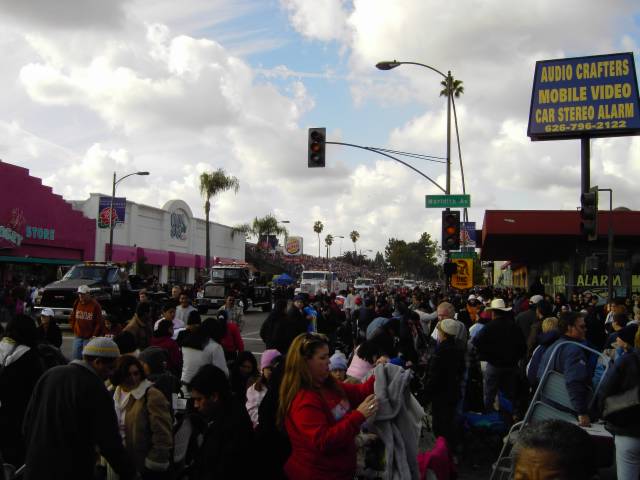
Well after a loud night, and a few wee hours of precious sleep, I got out and took a stroll down the block to the route, at around the 3 mile point in the parade. (It takes a day or two to recover, hence this late posting.) As is typical, campers were awakening, and starting the big day with a meal of coffee and doughnuts, although I did see one Mexican-style hot dog cart wheeled by (wrapped in bacon and cooked on a griddle).


Pasadena's "one-day" residents. Posted by Hello

Each year there seems to be agreement on what is the latest technological component to incorporate into the larger floats (not surprising, given that only several firms design and build almost all of the floats you see). This year was CO2 vapors, often paired with waterfalls or the tall JPL astronaut.

The panoramic angle of the television cameras really don't do the floats justice. When compared to the height of buildings or street lights, you get a better perspective. The giant panda float below was typical in size (although, the Honda-sponsored float of a multi-segmented train broke a record for longest float to date).


Your "typical" float. Posted by Hello

Most viewers think of the parade a consisting entirely of floats and marching bands. Yet, the origins were much more simple. In the earliest years, circa 116 years ago, The Valley Hunt Club
had their members tie roses and floral arrangements to horse-drawn carriages, which were then paraded along the streets (by the way, the VHC is still located on Orange Grove, where the parade begins). To this day, that tradition continues (and Pasadenans love their traditions, except when it comes to the PAC 10/BIG 10 in the Rose Bowl - goodbye) with at least one or two "old" floats, equestrian units, and sometimes the current leadership of the Valley Hunt Club (whose members created the Tournament of Roses).


The "original" Rose Parade. Posted by Hello

A few things most of you won't know: After the first few blocks, the parade doesn't flow as smoothly as on national TV. It is more like a catepillar, a few segments move and get crushed together and others are delayed. So there is more of a "start and stop" flow to most of it. This can be entertaining when marching bands get to take a standing break, or horses - given a moment of peace - elect to relieve themselves on the street (making an extra hazard for marching bands to follow).

When the parade stops, it can often mean that a float has broken down. Some years might have just the one or two floats experiencing "equipment malfunction," while several years ago I counted at least five which couldn't make it the full 5.5 miles. This year there weren't any that I saw (though, there were two more miles to go). In any event, the "real" last entry in the parade is the convoy of large-scale tow trucks at the ready.


The "unoffical" last entries in the parade. Posted by Hello

Finally, another shot you won't see in the big-time coverage. The trash, as you can imagine, is impressive. As soon as the parade is over (it takes about two hours), people flee with sleeping bags, tables, chairs and ladders, leaving almost everything else on the ground. Below is the sight the Chamber of Commerce never wants you to see. Yet, by this afternoon, it has been cleaned up. Late last night (actually, this morning) around 3:00 AM I could hear several street sweepers in action, clearing this mess away.


What the cameras never show. Posted by Hello

PS - As you can see, it didn't rain on the parade, as was predicted. The last time it did was in 1955 - a year my mother remembers and reminded me about this past weekend. Many (i.e., most) of us still believe that 116 years ago the Valley Hunt Club made a Faustian pact for perfect weather in January 1.

Well, that's it until the news summary tomorrow. I've got a bug and work calls in the morning. If any of you want more pics of the floats, feel free to drop me a line. If not, then this concludes the "Dark Side of the Rose Parade" series for 2005.

Friday, December 31, 2004

Dark Side of the Rose Parade V

UPDATE: 9:30 PM Pasadena Standard Time


Food, fires, fun. Posted by Hello

Well, this "Dark Side" report is finally "dark." As I write I can hear golden oldies tunes from the 80s being blared from some outside speaker, voices, and smell many fires and grills running at full blast. There are more food stalls this year than I remember selling hot dogs, hamburgers, tacos, fruit drinks and kettle corn. As a kid, it was lunch trucks, colloquially known as "roach coaches," that made for street food fun. Very few of those around in 2004.


More of the same. Posted by Hello

Since the Pasadena PD doesn't have enough officers for the crowds, most of Los Angeles County has been called in to help, both police and sheriffs. About an hour ago I saw four sheriff patrol cars take a break in the alley behind my duplex. Too bad they didn't catch the fool driving in reverse up my block at 30 mph. That weirdness, however, is par for the course on Colorado Blvd. tonight.


A good night's sleep. Posted by Hello

Currently, it's 51 degrees F (10 C) and will go down to around 43 F (6 C), so everyone is bundled up. With a couple of hours to go before midnight the sidewalks are crowded, the streets are packed with traffic, and everyone will try to stay awake for at least a couple more hours until the "big noise" of 2005. As for me, I'm signing off for the rest of tonight, and will head off to my Dad's in the morning to watch the parade in person and take lots of photos to post for you all tomorrow afternoon.

Happy New Year to all of you who read this little blog. May we all be saved from the wrath of nature, and the wrath of the American Executive Branch in the coming twelve months.

Dark Side of the Rose Parade IV


Municipal hospitality only goes so far.... Posted by Hello

UPDATE: 3:45 PM Pasadena Standard Time

A stroll down the block, and out onto Colorado Blvd. turns out to be full of obstacles, kids on bicycles attempting to amputate toes on the sidewalk, people filling air matresses, playing cards, lighting fires, and generally milling around, waiting for the mayhem at midnight, then catch a bit of sleep before watching the parade at around 9:00 AM at this midpoint in the route.

As I write this quick observation I hear car alarms going off, lots of traffic, and desperate horns
attempting to move both people and RVs, which seem to have taken over all major auto and pedestrian traffic paths.

At least the sun is coming out behind the clouds, but the ground is still very wet.


No space left untouched. Posted by Hello